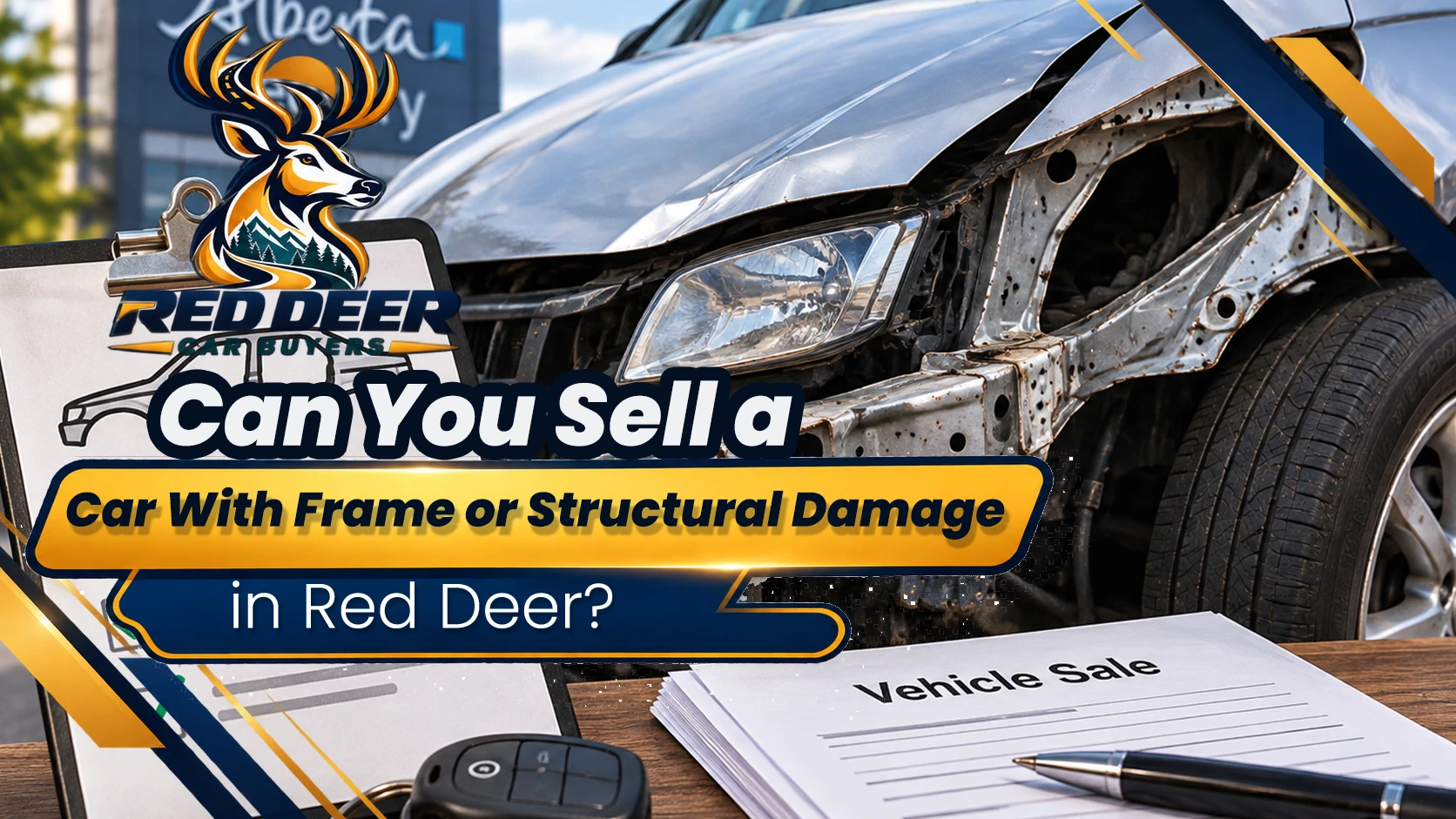
You can sell a car with frame damage in Red Deer, and anywhere else in Alberta, but the damage itself isn’t what decides how. The registry’s classification of the vehicle does, and that classification sets what you can sell it as and what you must hand the buyer.
Most sellers don’t know that Alberta has no registry status called “frame damage,” or that its Vehicle Inspection Regulation names specific frame and unibody damage that can make a salvage vehicle non-repairable. Treating every damaged vehicle the same way can leave a buyer with a car they can’t register and leave you facing a dispute. This guide explains how to sell a car with structural damage legally: which damage matters, what a seller must provide, what a buyer can do next, and the Red Deer steps for finishing the sale.
Frame Damage on Your Car? Sell It As-Is in Red Deer
If the damage has you weighing a costly repair against selling, Red Deer Car Buyers can make you an offer on the vehicle as it is, frame or structural damage included, so you don’t have to pay for repairs or an inspection first. Reach us at hello@reddeercarbuyers.ca or (587) 797-0700.
- Free Quote
- Same-Day Payment
- Local Red Deer Team
Can You Sell a Car With Frame Damage in Red Deer, or Does Alberta Block the Sale?
Alberta doesn’t block it. The province doesn’t prohibit selling a vehicle because it has frame or structural damage. When you sell a car with structural damage, the first question isn’t how bad the damage looks. It’s what the registry says about the vehicle, because that classification sets what the vehicle can be sold as, what you must give the buyer, and whether it can ever be registered again.
There are two broad situations. In the first, a status such as salvage or non-repairable has been assigned, and the Vehicle Inspection Regulation attaches specific rules to the sale. In the second, the damage was repaired privately or never reported, the registry still shows the vehicle as active, and the rules are far less specific. Both call for care, and the sections below take each in turn.
What Does Alberta Regulate When a Vehicle Has Frame or Structural Damage?
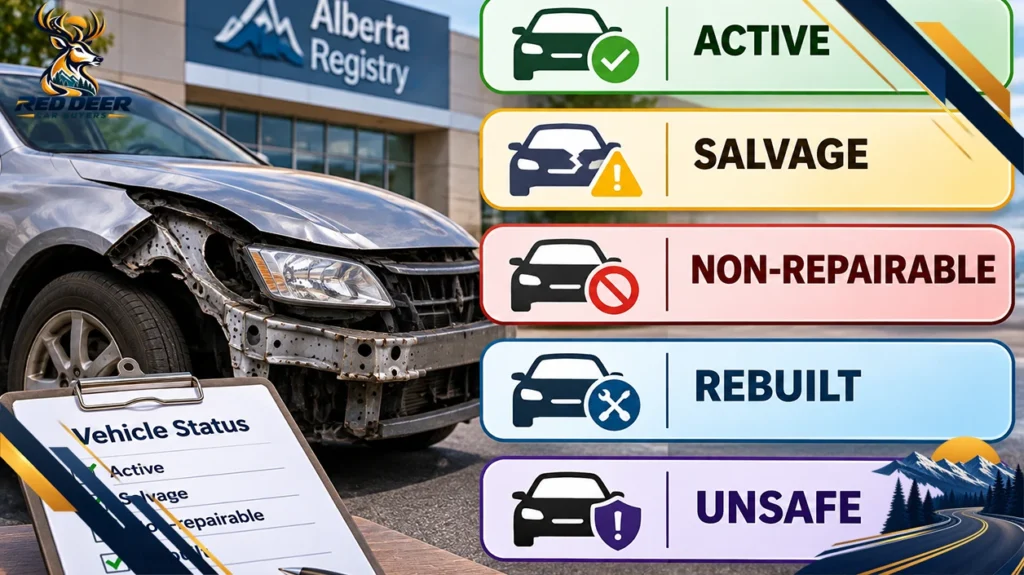
Alberta’s registry records statuses that include active, salvage, non-repairable, rebuilt, and unsafe. What each one means on a report is covered in the Vehicle Information Report guide. Here is what each means when you’re the one selling:
- Active: no declaration is on record, so the salvage-sale rule doesn’t apply unless another jurisdiction designated the vehicle salvage, but an accurate description of the damage still matters.
- Salvage: the regulation’s sale rule applies, and the vehicle can’t be re-registered until it passes a Salvage Vehicle Inspection.
- Non-repairable: the vehicle can’t be registered again and can only be sold as scrap or dismantled for parts.
- Rebuilt: the vehicle passed its Salvage Vehicle Inspection and was re-registered, and the status stays on record.
- Unsafe: the Registrar assigns this status, and registering the vehicle requires a current salvage motor vehicle inspection certificate. Confirm with Alberta Transportation how the sale rules apply, since the regulation’s sale rule is written for salvage vehicles.
How a Status Gets Assigned
Statuses come from declarations and reports set out in the regulation. An insurer, or a self-insured person, can declare a vehicle salvage under the regulation’s rules, and insurers and certain self-insured persons must notify the Registrar within 6 days after a vehicle becomes salvage. The Registrar can also assign a status under section 8 in cases involving structural or other defects, and a vehicle that another jurisdiction designated salvage, or something substantially similar, is treated as salvage once it’s brought into Alberta. The insurer-declaration rule doesn’t apply when the sole damage is hail damage to the outer body sheet metal.
Why Active Doesn't Mean Undamaged
An active vehicle can have structural damage. If it was repaired privately, or damaged without a salvage declaration, the registry may show nothing. Active status means no declaration is on record, not that the vehicle has never been damaged. A Vehicle Information Report also only covers Alberta, and a 2025 Alberta Consumer Services Appeal Board decision noted that status changes from other provinces aren’t carried into Alberta’s records on their own. A vehicle designated salvage elsewhere is still treated as salvage here, even when the Alberta record hasn’t caught up.
Which Frame and Structural Damage Makes a Vehicle Non-Repairable in Alberta?
Section 6 of the Vehicle Inspection Regulation says a salvage motor vehicle is non-repairable if it has no resale value except as a source of parts or scrap metal, “including, without limitation,” several listed conditions. Because the list isn’t exhaustive, the examples are guides, not a complete checklist. The structural examples depend on how the vehicle is built.
Full-Frame Vehicles
A full-frame vehicle is built with a separate frame under the body, which describes many pickups and larger SUVs. For these, the regulation’s example is extensive damage requiring replacement of both the cab and the frame. Damage that needs only one of those replaced isn’t the regulation’s stated example, so a bent frame alone doesn’t settle the question. Because the list isn’t exhaustive, though, damage that doesn’t match an example can still lead to non-repairable status if the vehicle has no resale value except as parts or scrap. What matters is the extent of the damage and the vehicle’s recorded status.
Unibody Vehicles
A unibody vehicle has no separate frame, because the body structure itself carries the load, which describes most cars and crossovers. For these, the regulation lists three conditions: collision or other damage to the passenger compartment floor, cowl, and A-pillar; collision or other damage to the rocker panel and B-pillar extending into the floor; or an opening made anywhere in the unibody as part of a rescue or recovery operation. The conditions are written as combinations, so read them carefully before assuming a particular repair situation fits.
What This Means If You're Selling
These conditions apply to salvage motor vehicles, and insurers have to report whether damage makes a vehicle non-repairable. The list also includes non-structural examples, such as damage by heat in two or more compartments and recovered stolen vehicles missing substantially all body panels or interior components. If you’re not sure whether structural damage on your vehicle fits, a status check through a registry agent shows how Alberta currently classifies it, and Alberta Transportation can explain how the rules apply. Don’t describe a non-repairable vehicle as repairable, because it can’t be registered again.
What Must You Give a Buyer When You Sell a Salvage Vehicle in Red Deer?
Section 13 of the Vehicle Inspection Regulation says a person can’t sell a salvage motor vehicle unless, before the sale, one of two things has happened:
- The buyer receives a current salvage motor vehicle inspection certificate for the vehicle, which means it has already passed a Salvage Vehicle Inspection.
- The buyer receives a written statement advising that the vehicle is a salvage motor vehicle for which there is no current salvage motor vehicle inspection certificate. This is the path for a vehicle sold as-is that still needs repairs and an inspection.
The rule is written to apply to “a person” selling a salvage vehicle, not only to dealers. The 2025 appeal board decision applied it to a licensed business, but the regulation’s wording is general. If you’re unsure how it applies to your sale, ask Alberta Transportation’s Carrier and Vehicle Safety office, whose contact details are on the salvage inspection page, or a lawyer.
The regulation requires a written statement but doesn’t prescribe its wording. A practical way to meet it:
- State the status in plain words, such as “salvage motor vehicle, no current salvage inspection certificate.”
- Put it in writing before the sale, because the rule says before, not after. The standard bill of sale has an optional “special conditions” field that works for this.
- Describe the known damage so the statement says what the buyer is actually getting.
- Keep a signed copy for your own records.
A vehicle from another province has a parallel rule. Section 14 says a person can’t sell an out-of-province motor vehicle unless, before the sale, the buyer gets a current out-of-province inspection certificate or a written statement that it’s an out-of-province vehicle with no current certificate. The out-of-province inspection guide covers that inspection.
What Should You Tell a Buyer About Structural Damage the Registry Doesn't Show?
Section 13 is specific to salvage vehicles. For damage that never led to a status being assigned, the most useful guidance is Alberta’s general buyer advice, which says that unless otherwise stated, used vehicles are sold “as is,” and flaws found after the sale are the buyer’s responsibility. That puts a lot of weight on what the seller says. A statement that isn’t true, or leaving out damage you know about while telling the buyer the vehicle is sound, is the kind of thing that leads to disputes and claims after a sale. Anyone who wants to sell a car with structural damage that was repaired privately should describe the damage, who repaired it, and any repair records in writing.
An active-status vehicle also hasn’t been through a Salvage Vehicle Inspection, which is the inspection where Alberta verifies structural integrity and repair methods for salvage vehicles, so nothing in the registry confirms how the repair was done.
Licensed automotive businesses face stricter rules. Since October 31, 2018, they have had to disclose vehicle history in writing before purchase, including whether the vehicle was ever declared salvage, non-repairable, or unsafe in Alberta or the equivalent in another jurisdiction. Those duties don’t describe a private sale, but they’re a useful checklist of what buyers expect to be told. If you’re unsure whether damage you know about creates a duty to disclose, ask a lawyer before the sale.
What Does a Buyer Need to Do Before a Salvage Vehicle Can Be Registered Again?
A buyer who wants to put a salvage vehicle back on the road has to repair it, pass a Salvage Vehicle Inspection, and register it again. Knowing the process helps you describe it accurately and gauge what a buyer will face.
The Salvage Vehicle Inspection Process
The process is set out on Alberta.ca. The buyer buys a Request for Vehicle Inspection form from a registry agent, contacts the inspection facility to discuss the intended repair method, and completes a Rebuilt Vehicle Work Plan. After the repairs, the buyer presents the vehicle, the form, and the work plan to the facility. The inspection can take up to 4 hours, and facilities set and post their own prices. If the vehicle passes, the certificate has to reach a registry agent within 14 days of issue, or a full Salvage Vehicle Inspection is required again, and the status changes from salvage to rebuilt.
How Structural Repairs Are Checked
Any collision damage affecting occupant protection, collision management, or structural integrity must be repaired using methods, standards, and specifications published by the vehicle’s manufacturer or by the Inter-industry Conference on Auto Collision Repair, known as I-CAR. The structural-integrity portion must be performed by an Auto Body Technician who holds a current Vehicle Inspection Technician license, and a different licensed technician does the mechanical portion. The work plan guide adds two practical points: a cab, frame, or electronic safety components from a non-repairable vehicle can’t be used, and photos of the damage help, because without them a technician may have to remove components to verify the repair, which can cost more than the posted inspection price.
Should You Repair a Structurally Damaged Car or Sell It As-Is in Red Deer?
There’s no universal answer. Repairing a salvage vehicle involves more than the physical repair bill. The process also includes a Rebuilt Vehicle Work Plan, a Salvage Vehicle Inspection, applicable inspection fees, and the registry steps afterward. Costs vary by vehicle, damage, and shop, so get more than one written estimate, and our guide on whether it’s worth fixing your car walks through the comparison.
A few questions usually settle it:
- What status does the vehicle have? A non-repairable vehicle can’t be registered again, so selling it as scrap or parts is the only route.
- Does the damage fit the regulation’s structural conditions? If it does, the vehicle may already be non-repairable, which changes the whole decision.
- What will it be worth afterward? A rebuilt status stays with the vehicle for the rest of its useful life, so the repaired value may differ from a similar vehicle with no salvage history.
- How long can you wait? The process involves a repair, an inspection appointment, and registry visits, and the vehicle can’t be registered until it’s done.
What Paperwork Do You Need to Sell a Damaged Car in Red Deer?
The paperwork for a damaged vehicle is the standard private-sale paperwork plus the status documents. In Red Deer, the registry steps happen at local registry agents, and the Government of Alberta’s registry agent lookup lists several Red Deer locations plus one in nearby Blackfalds. The Alberta car selling paperwork guide covers the full process.
- A completed standard bill of sale with every required field, including the vehicle’s make, model or series, style, color, and year, along with both parties’ names and addresses, the VIN, the sale price, and both signatures. For a damaged vehicle, also record the vehicle’s registry status and known damage in the optional special-conditions field or an attached signed statement. The bill of sale guide goes through each field.
- The salvage documents, if they apply: the current salvage motor vehicle inspection certificate, or the written statement that the vehicle is salvage with no current certificate.
- A lien check. Alberta’s guidance warns that a buyer who purchases a vehicle with an outstanding lien may be responsible for it, so run a lien search before the sale and deal with any lien before handing the vehicle over.
- Your license plates and registration. The plates stay with you, not the vehicle, so see the plate return and refund guide for what to do after the sale.
Selling a Car With Frame or Structural Damage in Red Deer? Get an Offer Without Repairing It
If the repair path doesn’t make sense for the vehicle, you don’t have to take it. Red Deer Car Buyers buys vehicles as-is, including ones with frame or structural damage, so you’re not paying for repairs or an inspection before you sell. Tell us the vehicle’s status and what happened to it, and we’ll give you a straightforward offer. Reach us at hello@reddeercarbuyers.ca or (587) 797-0700.
- Free Quote
- Same-Day Payment
- Local Red Deer Team
Frequently Asked Questions About Selling a Structurally Damaged Car in Red Deer
Yes. If no status was ever assigned, the registry shows the vehicle as active and the salvage sale rule doesn't apply, unless another jurisdiction designated it salvage. Alberta's guidance says used vehicles are generally sold as is unless stated otherwise, so describe the damage and repairs accurately and in writing.
Yes, if before the sale you give the buyer a written statement that the vehicle is a salvage motor vehicle with no current salvage inspection certificate. The buyer then handles the repairs and the Salvage Vehicle Inspection. Without that statement, or a current certificate, the regulation says you can't sell it.
No. The regulation's non-repairable test applies to salvage vehicles with no resale value except as parts or scrap, and its list is not exhaustive. Examples include extensive damage requiring replacement of both cab and frame on a full-frame vehicle, so a bent frame alone doesn't settle the vehicle's status.
A non-repairable vehicle can't be registered again. Alberta's guidance says it can only be sold as scrap or dismantled for parts. Whoever buys it for scrap or parts, or dismantles it, must notify the Registrar that it's non-repairable within 6 days of it becoming non-repairable.
Yes. If another jurisdiction designated a vehicle salvage or assigned it a substantially similar status and it's brought into Alberta, the regulation treats it as a salvage vehicle here. That's true even when the Alberta registry record doesn't yet show the status, so ask the seller for the vehicle's history.
The inspection can take up to 4 hours. Inspection facilities set the price for the inspection and any re-inspection, and they're required to post those prices in plain sight. Call a few licensed facilities before booking, since the Government of Alberta doesn't set one fee.
What Should You Do First Before Selling a Structurally Damaged Car in Red Deer?
Find out the vehicle’s registry status first, because everything else follows from it. A Vehicle Information Report shows the vehicle’s Alberta status, and a registry agent can confirm it. If the status is salvage, give the buyer the inspection certificate or the written statement before the sale. If it’s non-repairable, it can only be sold as scrap or parts. If it’s active but has structural damage or repairs, describe them accurately and put the description in writing. Anyone planning to sell a car with frame damage in Alberta is better off checking the status early and putting it on paper, and the same goes for anyone who needs to sell a car with structural damage. If anything about how a rule applies to your sale is unclear, ask Alberta Transportation or a lawyer before you sign.
References
- Government of Alberta. Salvage Vehicle Inspections
- Vehicle Inspection Regulation, Alta Reg 211/2006. CanLII
- Vehicle Inspection Regulation, Alta Reg 211/2006. Alberta King’s Printer
- Alberta Consumer Services Appeal Board. Decision in the matter of an appeal by Filmon Ghebregziabher operating as AFM Cars (June 17, 2025)
- Government of Alberta. Buying a Used Vehicle in Alberta
- Government of Alberta, Transportation. Buying a Used Vehicle in Alberta (as-is guidance)
- Government of Alberta. Rebuilt Vehicle Work Plan and completion guide
- Alberta Motor Vehicle Industry Council (AMVIC). Researching the Vehicle
- Government of Alberta. Standard Bill of Sale
- Government of Alberta. Vehicle Information Report
- Government of Alberta. Inspect Before You Buy
- Government of Alberta. Find a Registry Agent
- Government of Alberta, Alberta Transportation. Automotive & Light Truck Vehicle Inspection Manual