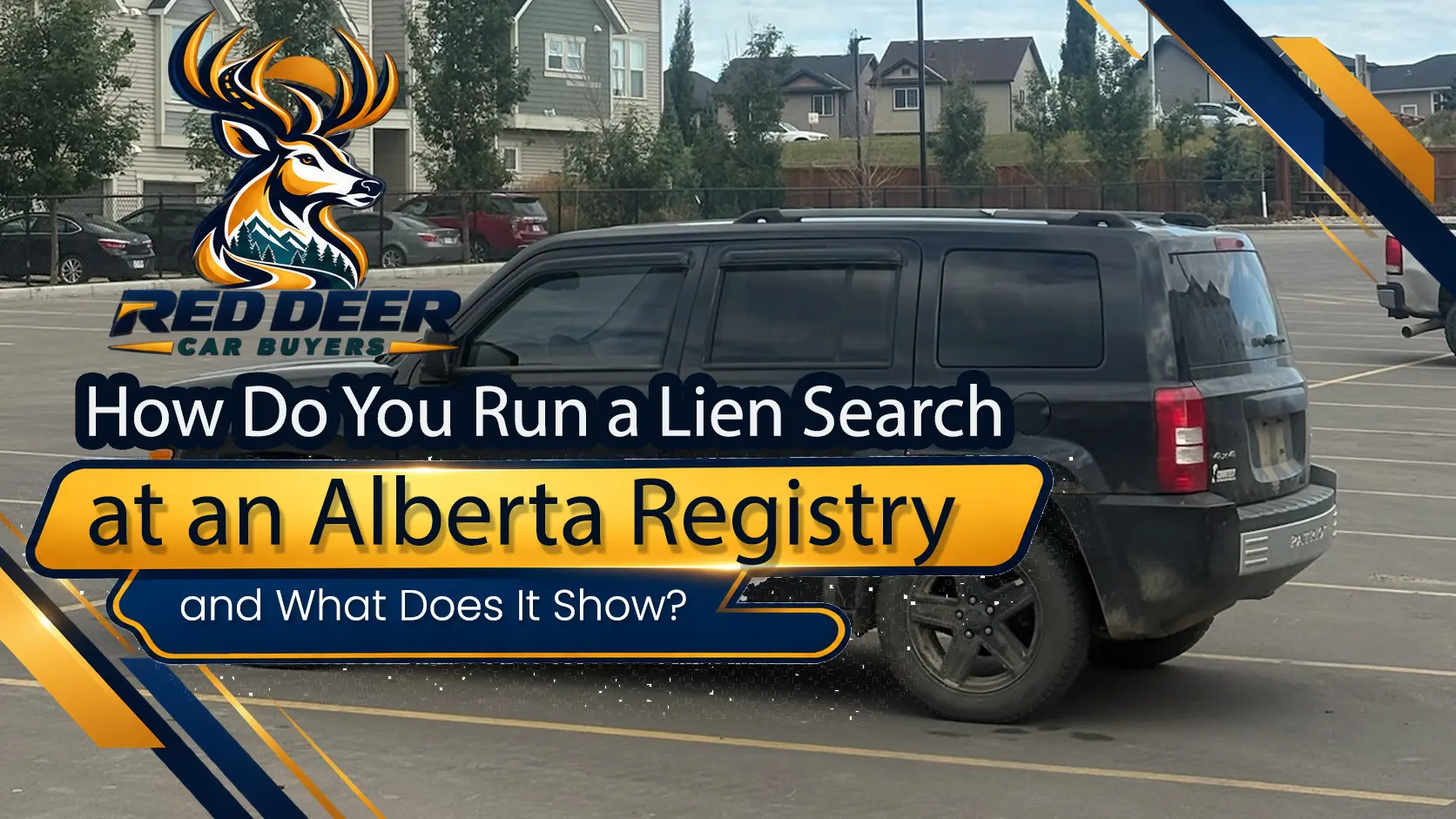
You’ve agreed on a price, the car looks clean, and the seller seems trustworthy. None of that tells you whether a bank still has a legal claim on the vehicle you’re about to buy. Running a lien search through Alberta’s Personal Property Registry takes just a few minutes at any registry agent, once you know what you’re actually asking for.
A registered security interest can affect a vehicle even after it changes hands. If you buy a vehicle with an undischarged lien, Alberta’s own guidance is direct about this: you may be responsible for it, even though the original debt belonged to the previous owner. This guide covers what a lien search actually checks, how much it costs, what the results mean, and what to do if one comes back positive.
Selling a Car With a Lien in Red Deer?
If you’re on the selling side and you know there’s still a balance owed on your vehicle, that complicates a private sale. Buyers who run a lien search, and increasingly they do, will see the registration and either walk away or demand you clear it before they’ll hand over payment. Red Deer Car Buyers can work with vehicles that still carry a lien; we handle the payout and discharge directly as part of the transaction, so you’re not stuck coordinating between a buyer, a lender, and a registry agent on your own. Reach us at hello@reddeercarbuyers.ca or (587) 797-0700.
- Free Quote
- Same-Day Payment
- Local Red Deer Team
What Is a Lien Search, and Why Does It Matter for a Used Car?
A lien is a registered legal claim against a piece of property, usually because someone financed it or a service provider is owed money for repairs or storage. In Alberta, these claims get recorded in the Personal Property Registry (PPR), a public database maintained by the government that anyone can search.
Two kinds of liens show up most often on vehicles. The first comes from a loan: if the previous owner financed the car and never paid it off, the lender’s security interest is registered against the vehicle under the Personal Property Security Act. The second is a garage keeper’s lien, which a mechanic or storage facility can register against a vehicle for unpaid repair or storage costs. Either one can create real problems for a buyer if it’s still registered when the vehicle changes hands.
How Do You Run a Lien Search at an Alberta Registry Agent?
The process itself is straightforward:
- Get the VIN. For a motor vehicle, trailer, or farm vehicle, the search is run against the vehicle identification number, not the owner’s name. Pull it directly off the vehicle rather than trusting the number on a listing.
- Fill out a search request form. Alberta’s Search Request form (REG3345) covers searches by serial number, individual debtor name, business debtor name, or a specific registration number. For a vehicle purchase, the serial number search is the one you want.
- Submit it at a registry agent. Any registry agent office in Alberta can process the request, including the ones right in Red Deer. You don’t need to go anywhere specific; any location can pull the same provincial database.
- Get your results. Searches typically come back quickly, often the same visit.
You can request this search whether or not you have any connection to the vehicle. It’s public information, and the person selling the car doesn’t need to authorize it or even know you’re running one.
How Much Does an Alberta Personal Property Registry Lien Search Cost?
A standard serial number search through a registry agent runs around $10 per search criterion, based on Alberta’s Registry Agent Product Catalogue, which lists personal property searches as a market-dependent service charge on top of that base. The exact total can vary slightly by agent. That small fee buys you a direct answer on whether the vehicle carries a registered claim, which is a lot cheaper than discovering the answer after a lender shows up asking about a car you just bought.
How Do You Read Your Lien Search Results?
Every lien search through Alberta’s Personal Property Registry comes back as one of four outcomes:
- Exact match. The search found a registration that matches your search criteria precisely. If you searched a VIN and got an exact match, there’s a registered interest against that specific vehicle.
- Inexact match. Something close came up, but it doesn’t line up perfectly. This usually calls for a second look, either by refining the search or running a registration number search on the specific result to confirm what it actually covers.
- No match. Nothing in the registry corresponds to what you searched. For a clean VIN search, this is the result you’re hoping for.
- Both exact and inexact matches. You’ll see this when the registry returns more than one type of result for the same search, which means you’ll want to review each one individually rather than assuming they all apply.
If your result shows a match, the registration itself will identify the secured party, meaning the bank, finance company, or repair shop that registered the interest, along with a description of what’s covered and the registration date. Any follow-up questions about the specific claim go to whoever registered it, not to the registry agent who ran your search.
It helps to think of the search result as a starting point rather than a finished answer. An exact match on a VIN tells you a registration exists, but it doesn’t tell you the dollar amount owed, the payment schedule, or whether the seller is already three payments from clearing it. For that level of detail, you’d contact the secured party named on the registration directly, since the registry itself only confirms that the claim is on file, not the specifics of the underlying debt. Sellers can usually request a current payout figure from their lender when a financed vehicle is being sold, which is useful to know if you’re close to a deal and don’t want a lien registration to end the conversation outright.
What Kinds of Liens Show Up on an Alberta Vehicle?
Most lien registrations against a vehicle fall into one of two categories. A financing lien means a lender has a security interest because the vehicle was financed and the loan isn’t fully paid off. A garage keeper’s lien means a repair shop or storage facility registered a claim because a bill for repairs or storage went unpaid. Both are fully legal, both are public record, and both transfer risk to a new owner if they aren’t cleared before the sale closes.
Municipalities can also register a specific type of lien, called a statutory charge, against a manufactured home for unpaid taxes, though this shows up far less often on an ordinary vehicle search. Whichever type of lien turns up, the underlying principle is the same: the search is tied to the registered collateral and the search criteria you enter, not to who currently possesses the vehicle or whose name is on the bill of sale. That’s exactly why checking the VIN matters even when the seller seems perfectly honest and the paperwork looks complete.
What Should You Do If a Lien Shows Up?
Finding a lien doesn’t mean the deal is dead. It means you stop and deal with it before any money changes hands.
Ask the seller directly about it. In many cases, the seller already knows the lien exists and is in the process of paying it off, in which case you’ll want proof of discharge before you finalize the purchase. If the seller can’t explain it or seems evasive, that’s a signal to walk away rather than negotiate around it. A lien that isn’t resolved before the sale is a debt that can follow the vehicle straight into your name, regardless of what the bill of sale says about the purchase price.
A workable path forward usually looks like this: get the payout amount from the lienholder named on the registration, agree on how that amount gets paid at the time of sale (often directly to the lender rather than to the seller), and treat written confirmation of discharge as the safest point at which to complete the bill of sale and registration transfer. Registry agents can help confirm a discharge has actually gone through once the lender has released it, so you’re not just taking the seller’s word for it.
Selling a Car With a Lien in Red Deer?
If you’re on the selling side and you know there’s still a balance owed on your vehicle, that complicates a private sale. Buyers who run a lien search, and increasingly they do, will see the registration and either walk away or demand you clear it before they’ll hand over payment. Red Deer Car Buyers can work with vehicles that still carry a lien; we handle the payout and discharge directly as part of the transaction, so you’re not stuck coordinating between a buyer, a lender, and a registry agent on your own. Reach us at hello@reddeercarbuyers.ca or (587) 797-0700.
- Free Quote
- Same-Day Payment
- Local Red Deer Team
How Do You Protect Yourself Before Buying or Selling in Red Deer?
A lien search costs about $10, takes a few minutes at any Red Deer registry agent, and tells you something a test drive and a handshake never will: whether someone else still has a legal claim on the vehicle. Run it against the VIN, read the result type carefully, and treat a match as a reason to ask questions rather than a reason to panic. Whether you’re buying your next car or making sure your own vehicle is clear before you list it, that small fee is one of the cheapest forms of protection available in a private sale.
Frequently Asked Questions
No. A Personal Property Registry search is public information, and anyone can request one using the vehicle's VIN. The seller doesn't need to authorize it or provide any documents before you visit a registry agent to run the search yourself.
No. A lien search only confirms whether a registered financial claim exists against the vehicle; it doesn't verify who the registered owner is. For ownership details, you'd need a Vehicle Information Report instead, which is a separate product from a lien search.
The lienholder's claim generally follows the vehicle, not the person who originally owed the money. That means you could end up dealing with a lender or repair shop's claim on a car you legitimately purchased, which is exactly why running the search before you pay is worth the small cost.
Most searches through a registry agent are processed quickly, often within the same visit. You'll typically know the result before you leave the office, which makes it easy to fit into the same trip where you're already reviewing a bill of sale or registering a vehicle.
No. A loan-based lien comes from a lender registering a security interest under the Personal Property Security Act. A garage keeper's lien comes from a mechanic or storage facility registering a claim for unpaid repair or storage costs. Both show up on the same search, but they represent different underlying debts.
Not necessarily. An inexact match means the registry found something close to your search criteria but not a precise match, which often just means a name or number is slightly different than expected. It's worth a closer look, usually with a registration number search, rather than an automatic red flag.