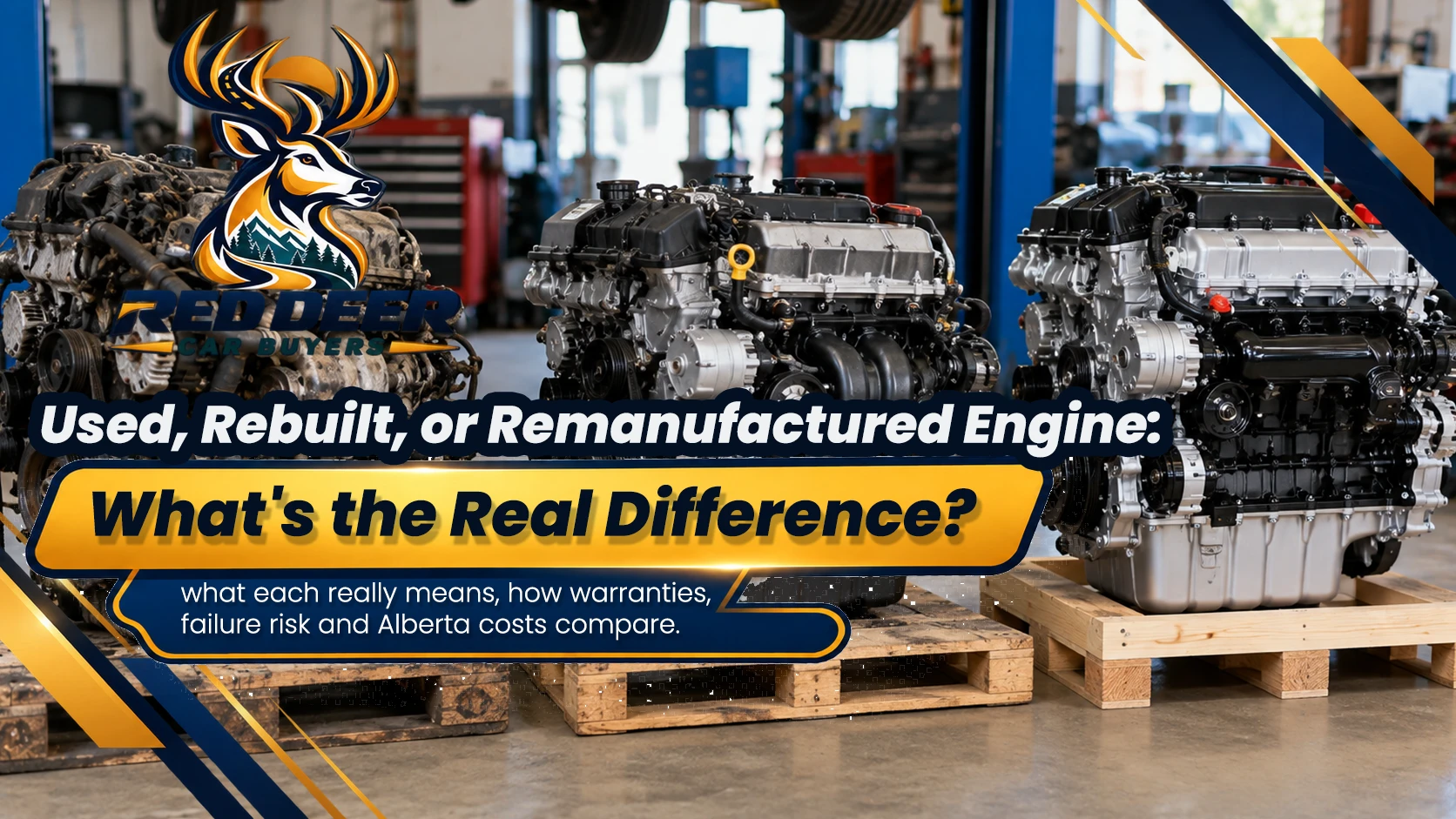
An engine shop offering to “rebuild” your engine and another offering a “remanufactured” unit might be describing two very different products, or the same one, depending on how loosely each shop uses the terms. There’s no firm industry consensus on where rebuilt ends and remanufactured begins, and a used engine often gets lumped into the same conversation despite carrying a completely different risk.
That inconsistency matters because it’s your money on the line. Getting the used vs remanufactured engine difference wrong can mean paying rebuilt-engine prices for a used engine’s uncertainty, or passing on a remanufactured unit’s real advantages. This guide explains what each term is generally supposed to mean, how warranties, failure risk, and Alberta costs compare, and the questions to ask before you choose.

Facing an Engine Replacement Quote?
Before choosing between used, rebuilt, and remanufactured, find out what the vehicle is worth as it sits. We buy cars and trucks with blown or failing engines in Red Deer, with same-day offers and payment before the vehicle is loaded. Reach us at hello@reddeercarbuyers.ca or (587) 797-0700.
- Free Quote
- Same-Day Payment
- Local Red Deer Team
Key takeaways
- A used engine is pulled from another vehicle and sold as is, with no inspection or replacement of worn parts.
- A rebuilt engine replaces worn parts but reuses parts still within wear limits, so its quality depends heavily on the shop.
- A remanufactured engine is restored to OEM specifications with key parts measured, machined, or replaced as standard.
- In central Alberta, an engine replacement runs about $2,700 to $7,000 with a used unit and about $4,500 to $11,500 with a remanufactured one.
What Is a Used Engine?
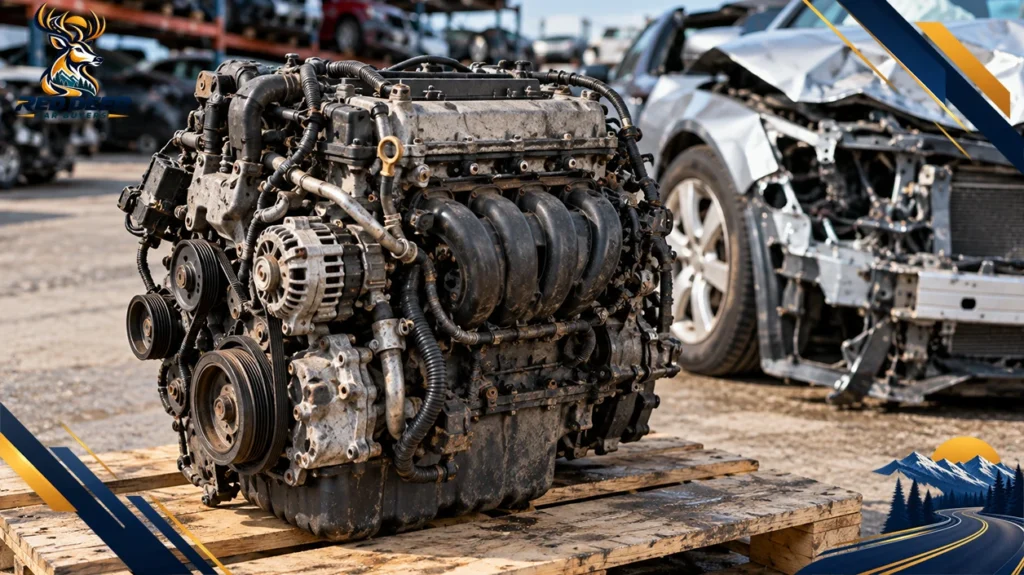
A used engine is pulled from another vehicle, often one written off after a collision, and sold without inspection or replacement of worn parts. What you see is what you get. A seller may provide a mileage figure from the donor vehicle, but that isn’t a guarantee of the engine’s actual condition.
- What you’re buying: The engine’s real mileage and maintenance history are usually unverifiable, since you’re relying on the seller or on records tied to the donor vehicle, not the engine itself.
- Where the savings come from: No labour goes into inspecting or replacing internal parts before it’s sold, so the price reflects the engine as it sat in the donor vehicle.
- The real risk: A used engine can fail from wear that was already present, sometimes shortly after installation, and the donor vehicle may have been in an accident or flood.
What Is a Rebuilt Engine?
A rebuilt engine is your own engine, or a comparable core, taken apart, cleaned, and inspected by a shop. Worn or damaged parts are replaced, but parts still within the manufacturer’s wear limits are usually reused rather than replaced as a matter of course.
Parts commonly replaced in a rebuild include piston rings, gaskets, bearings, seals, and valve springs, while the block and crankshaft may be reused if they measure within tolerance. That keeps the cost below a remanufactured unit, but it also means the finished engine’s reliability depends on how thorough that shop’s inspection was. Two shops doing “the same” rebuild can produce noticeably different results depending on what they chose to reuse.
What Is a Remanufactured Engine?
A remanufactured engine goes through a more standardized process, usually at a specialized facility rather than a general repair shop, with the goal of restoring it as close to new as possible. As DRiV’s engine guide explains, the head and block castings, camshaft, connecting rods, and crankshaft are measured to confirm they meet OEM dimensional tolerances, and parts such as pistons, rings, bearings, the timing chain, and the oil pump are commonly replaced with new or re-machined parts.
Many remanufacturers also test each finished engine before it ships. That combination of standardized measurement, replacement criteria, and testing is what generally justifies the higher price over a rebuild.
| Used | Rebuilt | Remanufactured | |
|---|---|---|---|
| Source | Another vehicle, as is | Your engine or a core, rebuilt by a shop | Core restored at a specialized facility |
| Worn parts | Not replaced | Replaced if out of limits | Measured to OEM specs; key parts replaced |
| Warranty | Often none or very short | Varies by shop, often short | More likely, more consistent |
| Central Alberta installed cost | About $2,700 to $7,000 | Usually between the two | About $4,500 to $11,500 |
Installed cost ranges are central Alberta figures reviewed in January 2026 and include parts and labour. Your quote depends on the vehicle.
How Do Warranties Compare?
Warranty coverage tracks closely with how much verification went into the engine before it reached you.
- Used engines: Often carry no warranty or only a short one, since the seller didn’t build or verify the engine.
- Rebuilt engines: Usually sit in the middle, and coverage varies more by shop than by any industry standard, since no single body audits every local rebuilder.
- Remanufactured engines: Are more likely to come with a warranty, and coverage tends to be more consistent between suppliers, though the length still varies.
None of these are fixed rules. Get the written warranty terms for parts and labour before assuming one category beats another.
Quick tip
Ask every seller the same three questions: which parts were replaced, what standard were they measured against, and what exactly does the written warranty cover, including labour? The answers tell you more than the label on the invoice.
How Do Failure Rates Compare?
A used engine’s risk is a continuation of whatever risk already existed in the donor vehicle, which makes it the hardest of the three to predict. If the previous owner skipped maintenance, that risk transfers to you. Running the donor’s VIN through an Alberta Vehicle Information Report can at least show its registration history and status.
A rebuilt engine’s risk depends on what the shop chose to reuse. A rings-and-gaskets rebuild that leaves a marginal bearing or borderline crankshaft in place can fail well before a remanufactured unit would. A remanufactured engine’s standardized criteria reduce that variation, though real reliability still depends on the supplier, the installation, and the warranty behind it.
How Do the Costs Compare in Alberta?
Price follows the same verification ladder as warranty and risk. In central Alberta, an engine replacement typically runs about $2,700 to $7,000 with a used unit and about $4,500 to $11,500 with a remanufactured long block, with 10 to 26 hours of labour either way, based on our repair-or-sell cost guide. A rebuild usually falls between the two, since shop labour to strip, inspect, and reassemble the engine is added to the parts, but without a remanufacturer’s standardized process.
The gap between options is large enough to change the decision on an older vehicle, so get quotes for each option on your specific vehicle before deciding.
Quick insight
Compare each quote against the vehicle’s value once repaired, not against each other. A $5,000 remanufactured engine can be a good buy on a truck worth $20,000 and a poor one on a car worth $6,000.
What Are Your Consumer Rights With an Engine Shop in Alberta?
Licensed automotive repair businesses in Alberta have obligations that apply directly to an engine replacement. Under AMVIC’s repair rules, a shop must:
- Get your consent before using rebuilt or salvage parts: A shop can’t install a used or rebuilt engine when you expected something else.
- Tell you in writing about the parts installed: Including whether they’re new, used, or reconditioned, and whether they’re original equipment or from another source. That’s the exact line between a used, rebuilt, and remanufactured engine.
- Stay within its estimate: A licensed repair business can’t exceed an estimate by more than 10 percent, and the increase can’t be more than $100, unless you agree to the added work first.
AMVIC also suggests comparing prices among repair shops for larger jobs, and an engine replacement is one of the largest.

Which Option Makes Sense for Your Situation?
The right choice depends less on which term sounds most reassuring and more on how long you plan to keep the vehicle and how much risk you’re willing to carry.
- Used engine: Can make sense on an older vehicle you won’t keep much longer, where a short or no warranty is an acceptable trade for the lowest cost.
- Rebuilt engine: Fits the middle ground when you trust the specific shop’s inspection standards and plan to keep the vehicle for a few more years.
- Remanufactured engine: Makes the most sense for long-term ownership, where warranty coverage and expected service life matter most.
Engine Trouble in Red Deer? Skip the Guesswork
If you’re facing an engine replacement on a vehicle you’re not sure is worth the investment, you may not need to choose any of the three. Red Deer Car Buyers buys vehicles with blown or failing engines as they sit, so you’re not weighing used against rebuilt against remanufactured on a car you may not want to keep. Offers come back the same day, towing is free across Red Deer, Red Deer County, and Gasoline Alley, and you’re paid before the vehicle is loaded. See how selling works, or reach us at hello@reddeercarbuyers.ca or (587) 797-0700.
- Free Quote
- Same-Day Payment
- Local Red Deer Team
Common Questions
No. A remanufactured engine is restored to OEM specifications using a mix of measured, re-machined, and new parts, while a new or crate engine has never been used. Remanufactured units cost considerably less than new ones while aiming for close-to-new condition.
A rebuilt engine has worn parts replaced by a shop, while parts within wear limits are reused. A remanufactured engine is restored at a specialized facility, with key components measured against OEM tolerances and many parts replaced as standard, which makes results more consistent.
It can, depending on the shop's standards and what was replaced. A thorough rebuild that replaces every worn part can come close to a remanufactured unit, but results vary more from shop to shop than with a remanufacturer's standardized process.
Because the seller usually didn't build or inspect the engine, so they can't guarantee its condition. Many used engines are sold with no warranty at all, and any coverage tends to be short.
Yes, but it's only part of the picture. Maintenance history matters as much, and it's usually the part you can't verify. A low-mileage engine that was poorly maintained can be a worse bet than a higher-mileage one that was cared for.
In central Alberta, an engine replacement typically runs about $2,700 to $7,000 with a used unit and about $4,500 to $11,500 with a remanufactured long block, including 10 to 26 hours of labour. Diesel engines cost considerably more.
Yes. AMVIC's rules require licensed repair businesses to tell you in writing whether installed parts are new, used, or reconditioned, and to get your consent before using rebuilt or salvage parts. Ask for this before agreeing to any option.
Used, Rebuilt, or Remanufactured: What's Worth Paying For?
The used vs remanufactured engine difference comes down to how much verification and standardization went into the engine before it reached you, and that verification is mostly what the price difference buys. There’s no formula that makes one option right by default, and the industry’s loose use of these terms means the label alone won’t tell you enough.
What protects you is asking direct questions before agreeing to anything: what was inspected, which parts were replaced, what standard the work followed, and what the written warranty covers. With those answers, the decision comes down to your vehicle’s situation rather than whichever word sounded best on the invoice.
References
- Alberta Motor Vehicle Industry Council (AMVIC). Repairing a Vehicle. https://www.amvic.org/consumer/repairing-a-vehicle/
- DRiV Parts. Should I Have My Vehicle’s Engine Rebuilt or Replaced? https://www.drivparts.com/parts-matter/learning-center/by-the-numbers/should-i-have-my-vehicles-engine-rebuilt-or-replaced.html
- AERA Engine Builders Association. About AERA. https://aera.org/about/