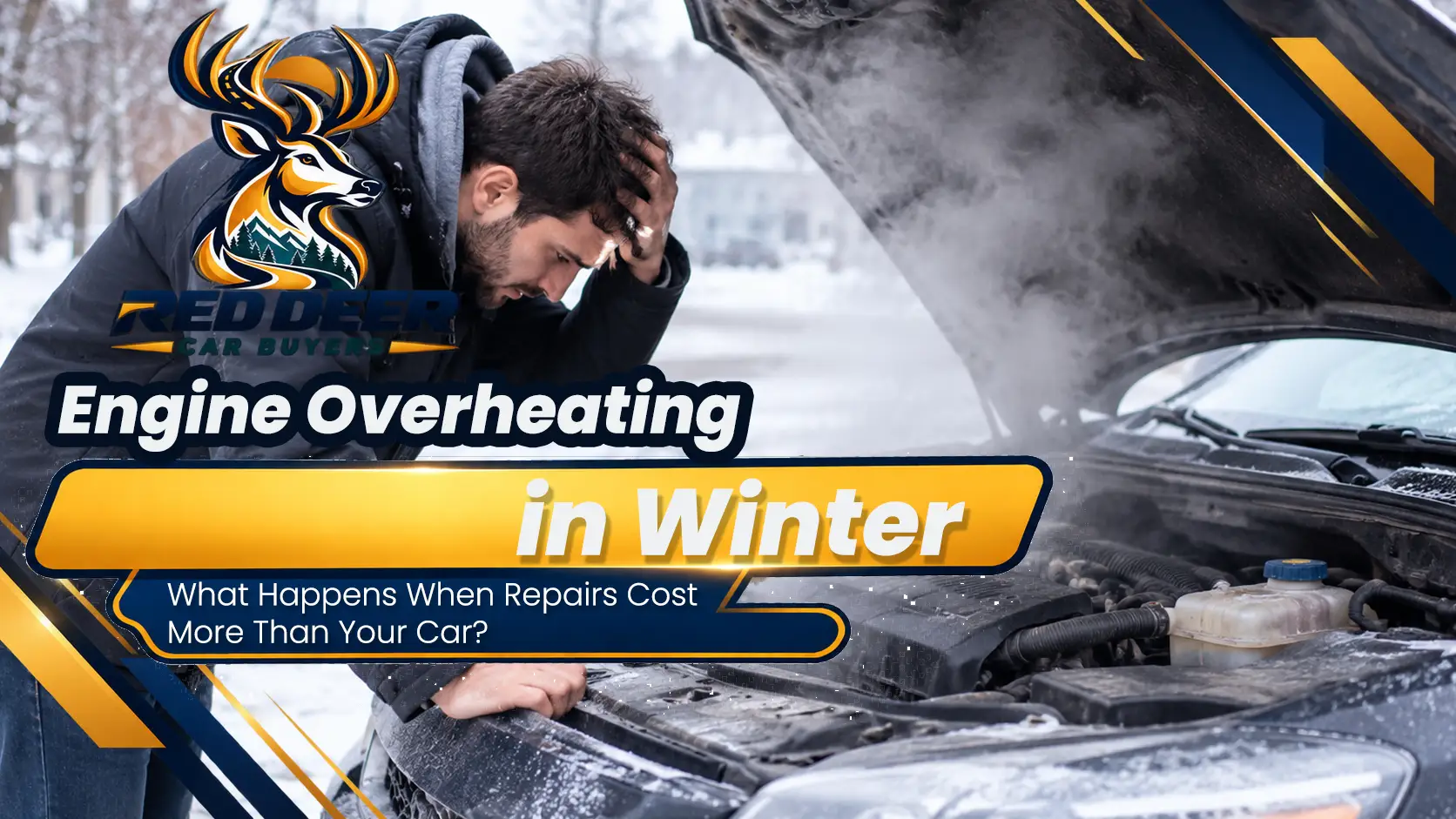
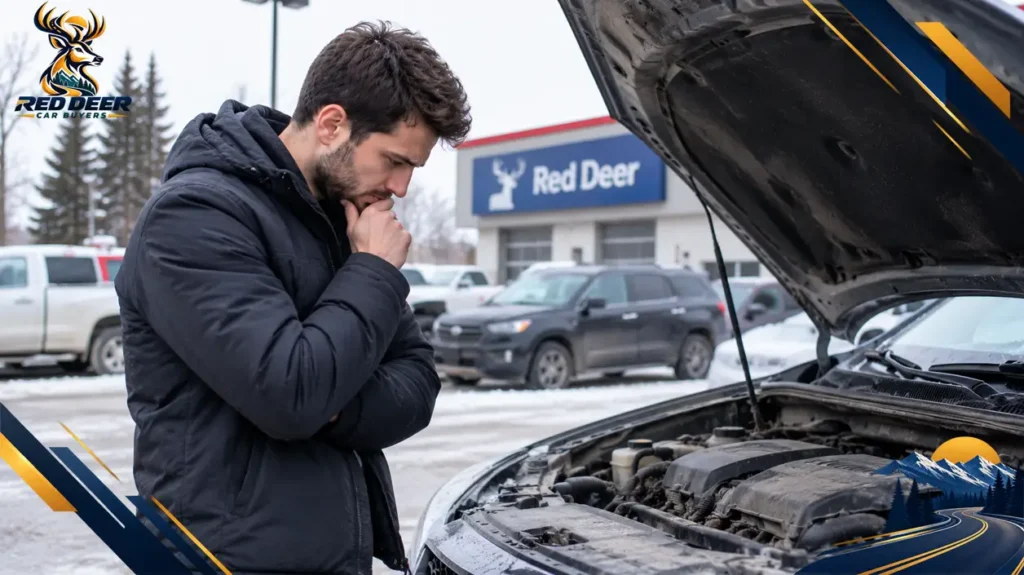
On a -30°C morning, a car that sat unplugged overnight limps with steam rolling out from under the hood. The skipped block heater made for a hard cold start. The steam comes from somewhere else: heat that couldn’t leave the engine. That’s the odd part of the engine overheating in winter. Cold air should keep an engine cool, yet a stuck thermostat, frozen coolant or a failed pump traps heat whatever the weather.
What happens in the next few minutes decides whether this is a cheap fix or an expensive one. Keep driving and a worn thermostat can turn into a warped cylinder head or a failed head gasket. This guide covers why engines overheat in the cold, what to do right after it happens, how to weigh a repair quote against the car’s value, and what your options are in Red Deer.
Engine Overheated? Get an As-Is Offer in Red Deer
If the repair quote is climbing toward what the car is worth, Red Deer Car Buyers can make you an offer on it as it sits, running or not, so you don’t have to pay for a diagnosis or repairs first. Reach us at hello@reddeercarbuyers.ca or (587) 797-0700.
- Free Quote
- Same-Day Payment
- Local Red Deer Team
Why does an engine overheat in winter?
An engine overheats in winter when coolant can’t carry heat to the radiator and out of the system. A closed thermostat, a radiator packed with ice or a pump that has stopped moving fluid defeats even the coldest air. Car overheating in cold weather most often comes from one of five causes, listed roughly from the cheapest repair to the costliest (prices shift with the vehicle):
- Low coolant or the wrong mix. A leak can leave too little coolant in the system to carry heat away. Separately, a mix with too much water gives weaker freeze and boil-over protection, and coolant that’s long past its service life has worn-out corrosion inhibitors, which invites deposits and corrosion over time. Checking the level, the mix strength and the coolant’s age is part of any winter checkup, along with the hoses, radiator cap, water pump and thermostat.
- A stuck thermostat. One stuck closed keeps coolant circulating inside the engine instead of through the radiator, so the gauge climbs fast even on a frigid morning. The part is small, and the labor depends on how hard it is to reach on your engine.
- A blocked or frozen radiator. Frozen coolant can stop circulation, snow or ice packed against the grille or radiator can cut airflow, and internal corrosion or deposits can narrow the coolant passages. Any of them leaves the engine heating up while the radiator does little.
- A failed water pump. When the pump quits, coolant stops circulating. Squealing from the front of the engine, a coolant leak or a heater that blows cold are common signs, and labor often runs higher because other parts have to come off first.
- A damaged head gasket or cracked block. This is the costly end. A bad head gasket can let coolant leak into the cylinders or the oil, and a cracked block can leak coolant inside or outside the engine. Either can follow an earlier overheat.
The overheating engine repair cost climbs quickly as you move down that list. Published estimates for central Alberta run roughly $1,500 to $3,000 for a gas-engine head gasket and $4,000 to $7,000 for a diesel one, parts and labor included. The first three items rarely raise a fix-or-sell question. The last two often do.
Frame Damage on Your Car? Sell It As-Is in Red Deer
- Free Quote
- Same-Day Payment
- Local Red Deer Team
How does cold weather make a damaged head gasket or cracked block worse?
Cold raises the stakes on failures already under way. Coolant diluted with too much water can freeze and expand inside the block, which is how blocks crack. Separately, a leaking head gasket or a cracked block leaves less coolant to carry heat away, so the engine overheats and the repair gets bigger. Red Deer’s average January overnight low is about -17.6°C, colder than the -15°C point where CAA suggests a block heater. A block heater only helps at the start of the day. On a timer set to switch on no more than two hours before you start the engine, it eases cold starts, and it doesn’t fix a leak, a weak mix or a cracked block.
What should you do right after your car overheats?
Stop driving. Even a few more kilometers with the gauge in the red can warp the cylinder head or blow a head gasket, and that turns a modest repair into one that’s hard to justify. Work through these steps in order:
- Pull over where it’s safe, shut the engine off and turn on the hazard lights. On the QEII near Gasoline Alley or on a Red Deer County road, use the shoulder.
- Leave the hood and the radiator cap alone while everything’s hot. The system is pressurized, and opening it can spray scalding coolant.
- Call for a tow instead of restarting the car to see if it makes it. At -30°C, tell the dispatcher it’s an overheated vehicle and that you’re waiting in the cold.
- Don’t open the system or add anything until the engine has fully cooled. Plain water thins whatever antifreeze is left, which is a freezing risk at -30°C, so if your owner’s manual allows water as an emergency fix, have the mix tested or flushed afterward.
- Write down what you noticed: steam, a sweet coolant smell, white exhaust, a warning light or how fast the gauge climbed. A shop can diagnose faster with those details, and they help when you compare estimates.
When do overheating repairs cost more than the car is worth?
One rule of thumb says repairing stops making sense once the quote passes about half of what the car would be worth after the fix. Treat it as a guideline. It only works with the car’s current market value, so look that up first instead of going by what you paid. The full repair-or-sell framework covers the complete method, so this section sticks to overheating.
How does the half-of-value rule apply to an overheated engine?
Head gasket repair vs sell car decisions come down to simple arithmetic. Take a car that would sell for $6,000 once it runs properly. Half is $3,000. A gas head gasket quoted near the bottom of the central Alberta range, about $1,500, clears that line comfortably. A used-engine swap starting around $2,700 sits just under it, and a remanufactured engine at $4,500 or more is already past it. Those figures are illustrative, so use your own quote and your own market value.
What makes overheating different from other repairs?
Overheating brings a second question: how much damage the engine took before it stopped. A car shut off quickly may need only the failed part, while one driven hot for kilometers might have a warped head, scored cylinders or coolant in the oil, and a shop may not know until it’s torn down. That uncertainty is a good reason to get a written diagnosis before approving work. Other repairs coming due, a diesel engine’s higher costs and high mileage all push the line below half. The same math applies to other big repairs, and transmission rebuild vs replace runs it for gearboxes.
What are your options in Red Deer: repair, replace the engine or sell as is?
Once the diagnosis and the numbers are in, there are three realistic paths. Whichever one you lean toward, ask for an itemized written estimate. Alberta’s repair rules let you request one from a licensed shop, limit increases to 10 percent or $100 without your approval, and suggest comparing prices on larger jobs.
Repairing makes sense when the failed part is inexpensive, the engine was shut off quickly and the car has solid life left. Ask the shop to pressure-test the cooling system and check the oil for coolant before you commit.
Replacing the engine fits a vehicle worth keeping long term. Used, rebuilt and remanufactured units differ in price, warranty and risk, which the used, rebuilt or remanufactured engine guide covers in full. On an older car, the price of a replacement engine rarely lines up with what the car is worth.
Selling as is skips the repair altogether and gives the most predictable result when the quote is past half the car’s value or the damage is unknown. A buyer prices what’s recoverable whether or not the car runs, and a local buyer collects it from a Red Deer driveway, a Red Deer County yard or a business lot in Gasoline Alley.
What happens when you sell an overheated car in Alberta?
Selling an overheated car works like any other Alberta vehicle sale, with a few extra questions because of the engine. A buyer will ask what happened, whether the car runs and how long it was driven hot. Straight answers get a firm offer, and the number only moves if something material wasn’t mentioned.
The paperwork starts with a signed bill of sale. Alberta’s standard bill of sale, form REG3126, is the form for private sales and records the full names and addresses of the seller and buyer, the VIN, the make, model or series, style, color and year, the price and both signatures. Alberta also says that automotive businesses must use a comprehensive bill of sale, so ask a business buyer which document it uses. Whichever form it is, keep a copy of the signed document and your payment record, and bring photo ID and your registration documents. If a lender still has a claim on the car, get a payout figure first.
Take your license plates off before the car leaves, then cancel the registration at a Red Deer registry agent (the province’s registry agent locator lists them) or ask the agent about moving the plates to another vehicle you own. Ask your insurer when coverage should end. The Alberta paperwork guide covers the registry steps and liens in more detail.
Can a Red Deer buyer take your overheated car as is?
Yes. Red Deer Car Buyers dispatches from Red Deer itself. We cover Red Deer, Red Deer County and Gasoline Alley, tow for free and pay by cash or e-transfer before the car is loaded. Send the year, make, model, kilometers and what happened, and you’ll usually get a callback the same day. Call (587) 797-0700 any day from 8 AM to 8 PM, or see what we pay for vehicles in any condition.
- Free Quote
- Same-Day Payment
- Local Red Deer Team
Common Questions About Engine Overheating in Winter
Cold air does nothing for an engine whose coolant isn't circulating. A thermostat stuck closed, a radiator blocked with ice or debris, a failed water pump or low, diluted coolant stops heat from leaving the engine. The gauge can climb even in extreme cold, so treat it like any other overheat and shut the engine off.
No. Even a few kilometers with the gauge in the red can warp the cylinder head or damage the head gasket. Pull over, shut the engine off, let it cool without opening the radiator cap and call a tow. A tow is usually a smaller expense than the repairs extra driving can cause.
It depends on the cause. Coolant and thermostat work sits at the low end, while a gas-engine head gasket runs about $1,500 to $3,000 in central Alberta and a diesel one $4,000 to $7,000. Actual quotes vary with the engine, labor hours and any heat damage, so get written estimates.
Yes. A buyer prices the car as it sits, so it doesn't need to run. Expect to share the year, make, model, kilometers and what happened, then provide photo ID, registration documents and a signed bill of sale. Your license plates stay with you, so remove them before the car leaves.
Is it worth fixing an overheated engine in winter?
The answer turns on two facts: which part failed and how long the engine ran hot. A thermostat or tired coolant on a car with years left is typically worth fixing. A head gasket, a cracked block or unknown heat damage on an older, high-kilometer car is where the quote starts closing in on the car’s value, and the half-of-value rule gives a quick first read. With engine overheating in winter, waiting has a cost: a damaged cooling system left outside through freezing nights can take further damage. Get a written estimate, compare it to the car’s current market value, and if the numbers don’t work, sell it as is and put the money toward your next vehicle.
References
- Alberta Motor Vehicle Industry Council. Repairing a vehicle.
- Government of Alberta. Standard bill of sale.
- Government of Alberta. Comprehensive bill of sale.
- Government of Alberta. Cancel a vehicle registration.
- Environment and Climate Change Canada. Canadian Climate Normals 1991-2020, Red Deer Regional Airport (January mean daily minimum).
- CAA National. Winter car care.
- Natural Resources Canada. Cold weather: how winter weather hurts fuel efficiency.