Most people find out what is wrong with their car while standing at the counter, reading a failure sheet they never saw coming.
That is a rough moment, especially when the repair estimates land close to what the vehicle is worth.
Alberta requires most vehicles brought in from another province to pass an out-of-province inspection before they can be registered and get local plates, though some exemptions apply. The inspection follows the province’s own Automotive and Light Truck Vehicle Inspection Manual, so the failure points are published and fairly predictable.
Knowing them early lets you price the repairs, compare shops, and decide whether the car is worth keeping before you spend anything. This guide covers the main areas where vehicles fail, what drives the repair cost in each one, and the Red Deer details on facilities, pricing, and exemptions.
How Does an Alberta Out-of-Province Inspection Work in Red Deer?
A licensed technician at a licensed facility checks your vehicle against the province’s official criteria. Technicians work from the Automotive and Light Truck Vehicle Inspection Manual, and the December 2009 edition is the one the province requires for out-of-province inspections. The Government of Alberta lays out each step on its out-of-province inspection page. A few rules are worth knowing before you book:
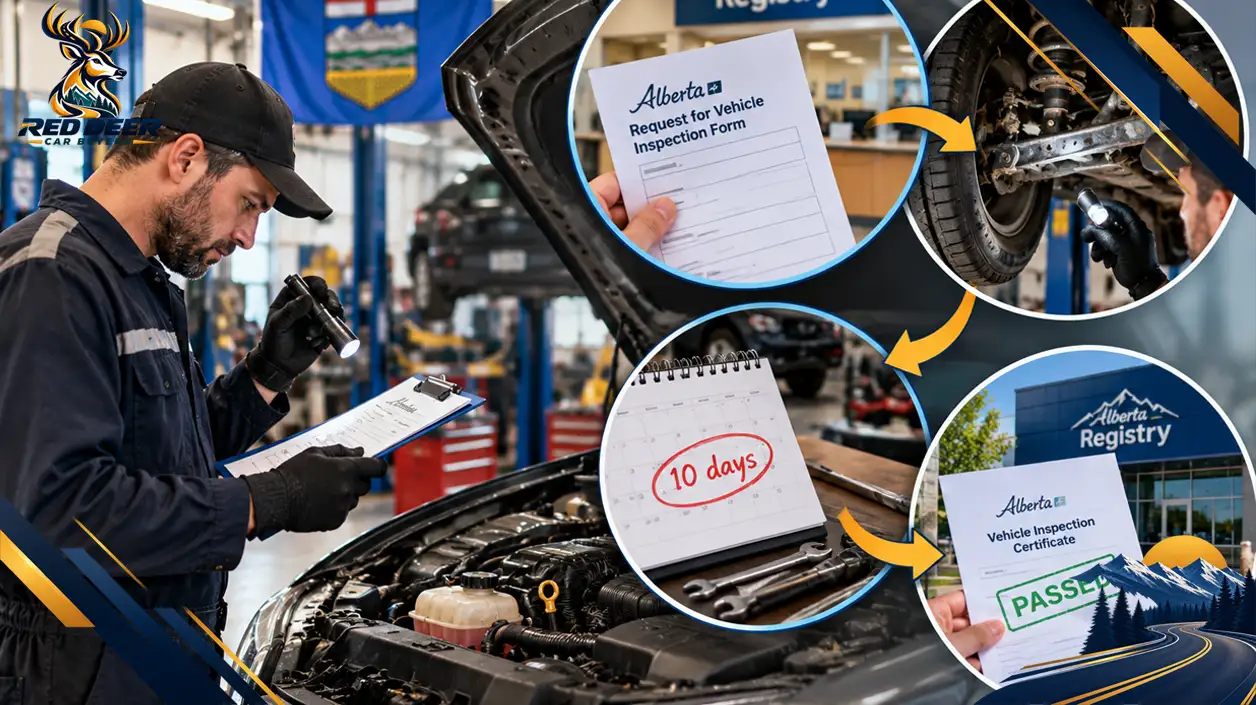
- You need a Request for Vehicle Inspection Form before the facility will start. Buy it from any Alberta registry agent. It doesn’t expire, so you can pick it up before you’ve chosen a facility. Our Alberta vehicle paperwork guide covers the rest of the registration paperwork.
- Inspection facilities set their own prices and must post them where customers can see them. There is no fixed government fee, so it pays to call a few.
- If the vehicle fails, you have 10 days to complete the repairs and present it for re-inspection. Do both inside that window and the facility only verifies the repairs, not the whole vehicle again. Miss it and you’re back to a full inspection.
- A passed inspection certificate must go to an Alberta registry agent within 14 days of the date it was issued. After that, the certificate is no longer accepted and you’ll need a new inspection.
How Do You Find a Licensed Inspection Facility Near Red Deer?
The Government of Alberta’s Vehicle Inspection Facility Search is the quickest way. Pick the inspection type, choose Out of Province, and enter Red Deer or your postal code. It lists the licensed facilities closest to you, so use it to confirm a shop is licensed before you book.
Before you leave the facility, ask for your Record of Inspection. It lists exactly what needs repair, and the 10-day repair window runs from the date printed on it.
How Much Does an Out-of-Province Inspection Cost in Red Deer?
There is no fixed government fee. Alberta leaves the price of an inspection or re-inspection to each licensed facility and requires them to post it in plain sight, and the vehicle owner pays it. The simplest way to find a fair price is to call two or three Red Deer facilities from the government’s search results before you book.
Ask what the inspection costs, what a re-inspection costs if you have the repairs done somewhere else, and whether the price changes for larger vehicles. Prices change, so take the number from the facility itself instead of relying on anything printed in an article.
Which Vehicles Can Skip the Out-of-Province Inspection in Alberta?
Not every vehicle that arrives from another province needs the full inspection. Alberta’s exemption guide sets out specific conditions, and each one applies only if the vehicle isn’t listed as flood-damaged, unsafe, salvage, or non-repairable. The New West Partnership rule matters most if you’re moving to Red Deer from a neighbouring western province.
Moving to Red Deer From BC, Saskatchewan, or Manitoba
A private passenger vehicle registered in your name in British Columbia, Saskatchewan, or Manitoba can be exempt in one of two ways. Either it is newer than four years, which Alberta counts as the current model year plus the previous three, or it is older but passed a government mechanical inspection in one of those provinces within the past 90 days. Only private passenger vehicles registered to the same person qualify, so commercial and organizational vehicles don’t. You’ll need a copy of the registration showing the vehicle is in your name.
New and Commercial Vehicles
A new vehicle from another Canadian province or territory can be exempt if you bought or leased it from a factory-authorized dealer within the last 90 days and the bill of sale or lease is in your name. A new vehicle from outside Canada has the same 90-day and dealer conditions, plus it needs a completed Registrar of Imported Vehicles inspection and Transport Canada’s Form 1 stamped twice. A commercial vehicle from another province can be exempt with a valid commercial vehicle inspection certificate issued within the last 90 days.
Vehicles That Can Never Be Exempt
Some vehicles have to be inspected no matter where they came from or how new they are. Alberta’s guide lists these as ineligible for an exemption:
- Flood-damaged, unsafe, salvage, and non-repairable vehicles
- Rebuilt vehicles
- Right-hand drive vehicles
- Custom or homebuilt vehicles and kit cars
- Lifted or lowered vehicles
If you think your vehicle qualifies for an exemption, bring it to an Alberta registry agent along with your identification, proof of insurance, and your bill of sale, previous registration, or importation forms. Red Deer has several registry agents, so you don’t need to travel for it.
Which Glass and Windshield Problems Fail an Out-of-Province Inspection?
Glass is one of the easiest categories to check, and even a small chip in the wrong spot can fail you.
In the area the wipers sweep, the manual rejects a windshield with any crack, or with a blemish larger than 12 mm in diameter. The area under the inside mirror and a 75 mm strip along the top and bottom of the windshield are excluded from that rule. A crack through both layers of glass also fails, and so does a crack that runs to another edge, or back to where it started, inside the wiper-swept area.
Tint is the other common problem. Front side windows can’t have any aftermarket tint, and windshield tint is only allowed as a strip at the top that reaches no more than 150 mm (6 in) down the glass. Glass that is pitted, scratched, or discoloured enough to affect the driver’s visibility fails too, whether it’s the windshield or a side window.
Glass costs depend heavily on the vehicle and the shop, and windshields with a camera mounted to the glass tend to cost more to replace. Get a written quote before you commit.
What Tire and Wheel Problems Fail the Inspection?
Tires and wheels are checked on every vehicle, and they’re easy to overlook on a car that hasn’t had new rubber in a while.
- Tread worn down to the wear bars anywhere across the tire fails. This is checked on every tire, not only the worst-looking one, and the technician records the tread measurement.
- Mismatched tire sizes on the same axle, tires not rated for road use, or a tire that touches the body or suspension all fail on the spot.
- Bent, cracked, or welded rims, and wheel studs or nuts that are missing, stripped, or broken, have to be corrected before the vehicle passes.
What Steering and Suspension Problems Fail an Inspection in Red Deer?
Steering and suspension wear tends to show up on vehicles that have spent time on rough roads or through harsh winters. It’s also one of the pricier categories, because once one worn part starts loading stress onto the next, the bill grows.
Tie Rod Ends and Ball Joints
Inner and outer tie rod ends, and front and rear ball joints, fail when they’re worn beyond serviceable limits. The technician follows the manufacturer’s published inspection procedures to judge that. Wear on these parts builds up on vehicles that have spent years around heavy road salt or rough roads. A ball joint left too long can put extra stress on the control arm and hub, which turns a moderate repair into a much larger one. Replacing steering components usually calls for a wheel alignment afterward, and that adds to the bill.
Struts, Shocks, and Control Arms
A vehicle fails if it doesn’t pass the bounce test, if a shock or strut leaks fluid or is loose, or if a strut’s upper bearing is loose, rough, or binding. A thin film of fluid on a shock or strut isn’t grounds for rejection on its own.
The bounce test is what it sounds like. The technician pushes down on each corner of the vehicle and watches how it recovers. A strut that has lost its damping keeps the car bouncing instead of letting it settle.
Control arms, trailing and radius arms, strut rods, and sway bars fail when they’re worn beyond serviceable limits, welded, or missing mounting hardware. Weathered rubber bushings aren’t automatically a fail, but a bushing worn beyond serviceable limits is treated the same as any other worn part.
When a Four-Wheel Alignment Is Required
Alberta requires a four-wheel alignment on salvage vehicles and on out-of-province vehicles that show any of the indicators listed in the manual:
- Evidence of collision damage or recent structural repairs
- Premature or abnormal tire wear
- Four new tires on a used vehicle
- An off-center steering wheel
- New steering or suspension components installed before the inspection
- Abnormal road-test results
- Any condition the technician believes calls for one
Each of these is a common sign that the steering or suspension geometry has shifted, even when nothing looks broken. The alignment is billed separately from the inspection and from whatever repair prompted it, so ask the facility how it prices that step.
What Brake Problems Fail an Out-of-Province Inspection?
Brakes are measured with tools, so a technician can’t pass a system that’s near the limit just because it feels fine on a test drive.
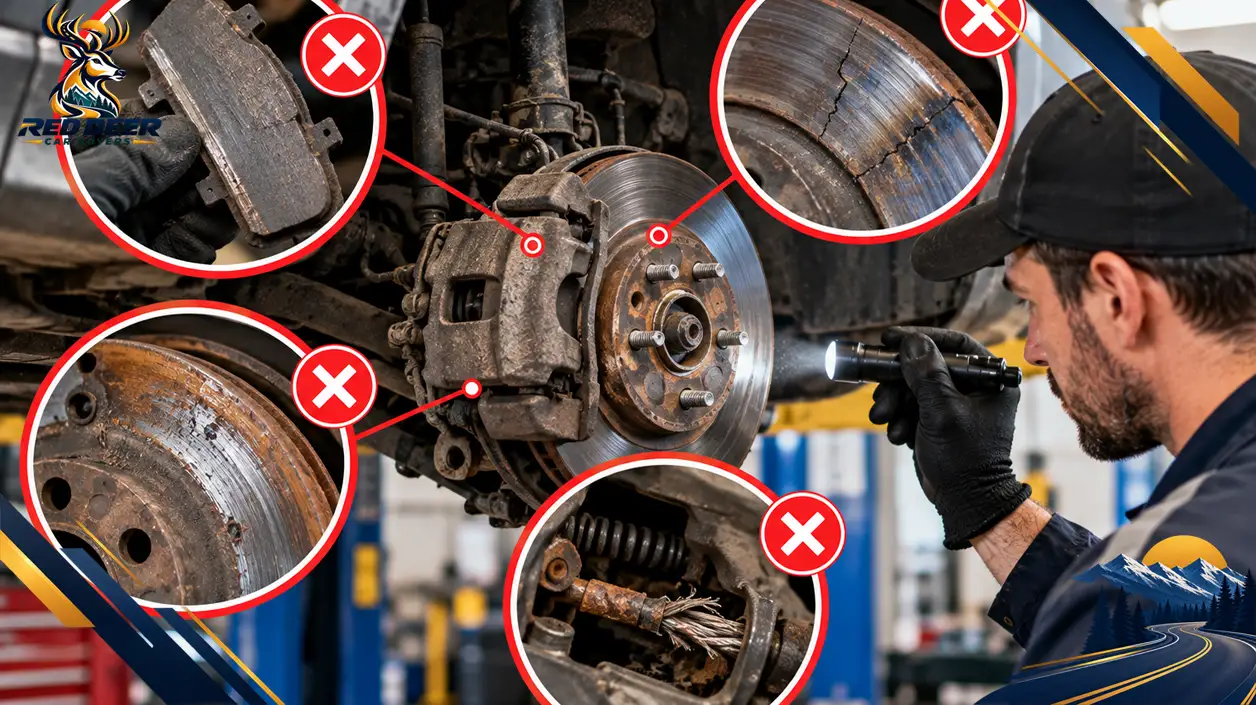
- Brake linings worn to 1.6 mm or less, cracked, or contaminated fail, and the technician records the actual measurement. A seized, leaking, or worn caliper or wheel cylinder also fails.
- Brake rotors fail for cracking, heat spots, pitting, or blue discoloration, for thickness below the manufacturer’s published service limit, or for a score or groove deeper than the manufacturer allows.
- Brake drums are assessed separately. They fail for grooves the technician believes would affect braking, hard or glazed spots, cracking, a diameter beyond the manufacturer’s limit, or a score or groove deeper than allowed.
- The parking brake has to hold the vehicle stationary, release properly, and be adjusted within specifications. Frayed or seized cables fail it. It’s tested on every inspection.
Which Lighting Problems Fail an Inspection in Red Deer?
Most lighting failures are cheap to fix one at a time, but they add up on a vehicle that hasn’t been driven much after dark.
- Any lamp that’s out, cracked, or not securely mounted fails, including brake lights, marker lamps, and license plate lamps. This covers decorative lighting too, such as underbody ground effect lights.
- Daytime running lamps that don’t work, or that can easily be disabled, fail on vehicles built on or after December 1, 1989.
- Headlamps that are out of alignment fail, though realigning them is usually a quick adjustment and not a parts replacement.
- A high-mount stop lamp blocked by aftermarket tint or a canopy fails just as surely as one that’s burned out.
What Body, Exhaust, and Structural Problems Fail an Inspection?
This category is where a routine inspection most often becomes a decision about whether the vehicle is worth keeping, because the repairs here can be the most expensive on the list.
Structural Rust and Corrosion in Central Alberta
Severe structural corrosion can fail the vehicle outright. That includes perforation of the frame, floor pan, or rocker panels, and any corrosion that compromises structural integrity. So does corrosion bad enough to let exhaust gases into the passenger compartment. Repair costs vary enormously with severity, and on a vehicle that spent years around road salt the work can cost more than the car is worth.
Central Alberta isn’t salt-free either. Red Deer County reports spreading about 4,500 metric tons of sand and salt on county roads in an average year. Whichever province the vehicle came from, have someone look at the frame and floor pan before you pay for the official inspection.
Exhaust System Problems
Exhaust leaks, missing heat shields, and broken hangers fail, and so does any exhaust that ends under the vehicle instead of behind it. A section within 50 mm (about 2 inches) of combustible material, an electrical wire, a fuel or brake line, or the fuel tank fails unless it has an appropriate heat shield. The concern there is fire risk as much as noise. The exhaust also has to be OEM or equivalent, so a replacement section of the wrong type can fail even if it doesn’t leak.
Seatbelts, Airbags, and Fluid Leaks
Missing or non-functional seatbelts, frayed webbing, and a missing airbag all fail. An airbag cover that has been painted or repaired fails too, even if the airbag itself is intact, because it’s treated as tampering with a safety system. Fluid leaks from the brake or clutch master cylinder, or an engine oil leak the technician considers a fire hazard, fail no matter how well the vehicle drives.
Bumpers, Fuel Caps, and Aftermarket Equipment
A missing fuel cap, a bumper with torn or protruding metal, and aftermarket equipment that isn’t securely mounted all fail. A loose truck bed toolbox or an unsecured aftermarket fuel tank falls into the same group, as do welded, cut, or missing bumper reinforcement and missing bumper impact absorbers.
A missing fuel cap or a loose accessory is cheap to fix. Damaged bumper components and poorly secured fuel-system equipment can cost a lot more, so confirm what repair is required and get a quote before assuming a minor-looking problem will be cheap.
What Should You Do When Repair Quotes Come Out Higher Than the Car Is Worth?
Do the math before you put money into an older vehicle. Once you’ve worked through each failure category and priced the repairs, say tires, brakes, a tie rod end, and some rust work, the total can approach or pass what the vehicle would sell for on the road.
A car that needs major suspension and rust work may not be a good investment, especially if you plan to sell it soon after. Write the numbers down category by category instead of eyeballing them. A tie rod end here and a set of tires there climb fast when you were only budgeting for the one big repair you already knew about. If you’re stuck on the decision, our guide on whether it’s worth fixing your car walks through it.
Labour rates vary from shop to shop, so get written estimates from more than one Red Deer shop. A licensed repair shop must give you an estimate in writing if you ask for one, and AMVIC, Alberta’s regulator for the industry, recommends comparing prices among shops on larger jobs.
Failed the Inspection and Don't Want to Fix the Car? Sell It As-Is in Red Deer
If the estimate comes back higher than you expected, you don’t have to sink money into a vehicle you weren’t planning to keep long-term. Red Deer Car Buyers buys vehicles as-is, including ones that failed an out-of-province inspection, so you’re not paying for repairs just to make the car sellable. If that sounds like your situation, see how we handle cash for junk cars in Red Deer, or reach us at hello@reddeercarbuyers.ca or (587) 797-0700 for a straightforward offer.
- Free Quote
- Same-Day Payment
- Local Red Deer Team
How Do You Get Through the Inspection Without Surprises in Red Deer?
The most common failure areas are worn tires, a cracked windshield, tired suspension parts, brake wear, small lighting problems, and rust. Going in with a rough idea of what usually fails turns the inspection from a surprise into a checklist.
In Red Deer, that also means checking whether your vehicle qualifies for an exemption, buying the form at a local registry agent, using the government’s facility search, and comparing posted prices before you book. If the repair bill starts creeping toward what the car is worth, that’s your cue to weigh selling it as-is against putting more money into a vehicle you may not want to keep anyway.
Frequently Asked Questions About Out-of-Province Inspections in Red Deer
There is no fixed government fee. Each licensed facility sets its own price and has to post it where customers can see it. Use the government's facility search to find licensed facilities near Red Deer, call two or three to compare, and ask whether re-inspections or larger vehicles are priced differently.
At any Alberta registry agent. The Government of Alberta's registry agent lookup lists several Red Deer locations. The form doesn't expire, so you can buy it first, pick a licensed inspection facility with the government's search, and bring the form along with the vehicle.
Sometimes. A private passenger vehicle registered in your name in BC, Saskatchewan, or Manitoba can be exempt if it's newer than four years, meaning the current model year plus the previous three, or if it passed a government mechanical inspection there within the past 90 days. Salvage, rebuilt, and lifted vehicles never qualify.
No. You can take the vehicle to any licensed repair shop for the work. Then book the re-inspection with the facility that did the original inspection, and check with them first if you'd rather use a different one. The 10-day repair window applies either way, no matter who does the repairs.
The vehicle needs a new full inspection instead of a check of only the failed items. That usually means paying for a second complete inspection, so start on the repairs as soon as you get the results.
Check with your insurer first. A vehicle with a serious safety defect, such as failing brakes, shouldn't be on the road at all, whatever the paperwork says.
Rebuilt vehicles aren't eligible for an exemption, so they have to be inspected. Salvage vehicles go through a separate, two-part Salvage Vehicle Inspection. A licensed Automotive Service Technician or Heavy Equipment Technician does the mechanical portion, and a properly licensed Auto Body Technician does the structural integrity portion.
Often, yes, especially if the vehicle has been sitting or has spent years around heavy road salt. A mechanic you trust can flag likely problem areas, like structural rust or worn suspension parts, before you pay for the official inspection and find out the hard way.
References
- Government of Alberta. Out-of-Province Vehicle Inspections. https://www.alberta.ca/out-of-province-vehicle-inspections
- Government of Alberta, Alberta Transportation. Automotive & Light Truck Vehicle Inspection Manual. https://open.alberta.ca/publications/automotive-light-truck-vehicle-inspection-manual-version-1
- Government of Alberta. Vehicle Inspection Program: Manuals. https://www.alberta.ca/vehicle-inspection-program-manuals
- Alberta Motor Association. Out of Province Vehicle Inspections in Alberta. https://ama.ab.ca/registries/auto/vehicle-inspection/out-of-province
- Government of Alberta, Transportation and Economic Corridors. Registering an Out-of-Province Vehicle in Alberta (exemptions guide). https://www.alberta.ca/system/files/tec-registering-an-out-of-province-vehicle-in-alberta.pdf
- Government of Alberta, Transportation. Vehicle Inspection Facility Search. https://www.transportation.alberta.ca/vis/production/vishome.asp
- Government of Alberta. Find a Registry Agent. https://www.alberta.ca/lookup/find-a-registry-agent.aspx
- Red Deer County. Winter Maintenance & Snow Removal. https://www.rdcounty.ca/164/Snow-Removal-Winter-Maintenance
- Alberta Motor Vehicle Industry Council (AMVIC). Repairing a Vehicle. https://www.amvic.org/consumer/repairing-a-vehicle/