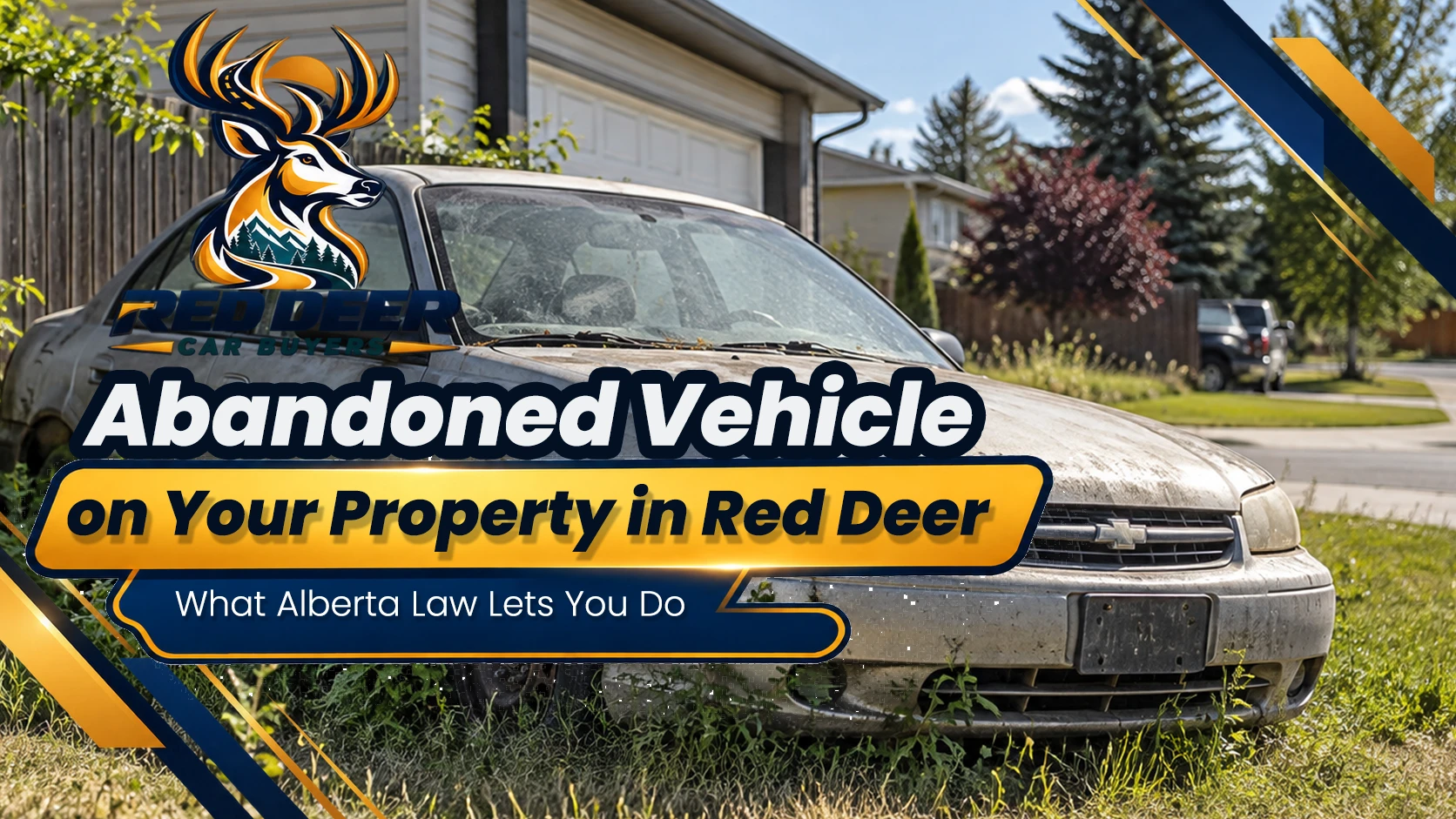
An abandoned vehicle on your property in Red Deer usually falls into one of two very different legal categories, and which one applies changes everything about what you’re allowed to do next. If the vehicle belonged to a former tenant, Alberta’s Residential Tenancies Act gives you a specific, well-defined process. If it belonged to someone else entirely, a stranger, a previous property owner, or someone whose connection to you is unclear, there’s no simple “finders keepers” rule, and claiming ownership without going through the right channel can create real legal exposure.
This guide walks Red Deer property owners through both paths: what you can do with a former tenant’s vehicle, what your options actually are when the vehicle isn’t a tenant’s, how to identify who owns it, and where Red Deer’s municipal bylaws fit into the picture.

Sold Your Way Through the Paperwork in Red Deer? We'll Take It From There
Once you’ve gone through the right process, whether that’s the tenant-vehicle rules under the Residential Tenancies Act or proper legal advice on a non-tenant situation, and you’re actually in a position to sell, Red Deer Car Buyers can make things simple from there. We buy vehicles in all kinds of condition, including ones that have been sitting unused for a while, and we’re used to working with sellers who need to show documentation proving they have the right to sell. Reach us at hello@reddeercarbuyers.ca or (587) 797-0700.
- Free Quote
- Same-Day Payment
- Local Red Deer Team
Does It Matter Whether the Vehicle Belonged to a Tenant?
Yes, enormously. Alberta law treats these as two completely separate situations:
- A tenant’s vehicle left behind after they moved out or abandoned the rental unit falls under section 31 of the Residential Tenancies Act, which gives landlords a specific legal process for dealing with it.
- Anyone else’s vehicle, meaning it wasn’t left by a tenant under a residential tenancy agreement, doesn’t fall under that Act at all. There’s no equivalent provincial statute that hands a property owner a clean, step-by-step process for claiming or selling it.
Before doing anything else with an abandoned vehicle, figure out which category it falls into. That single question determines whether you have a defined legal path or need to take a more cautious, multi-step approach.
What Can Red Deer Landlords Do About a Former Tenant's Abandoned Vehicle?
If the vehicle belongs to a tenant who abandoned the rental premises, or vacated after their tenancy expired or was terminated, section 31 of the Residential Tenancies Act applies. The rules break down by value and circumstance:
- Under $2,000 in market value. If you believe on reasonable grounds that the vehicle is worth less than this prescribed amount, you can dispose of it without going through a storage period at all. This covers the common case of a truly worthless vehicle that isn’t worth the hassle of a formal sale process.
- Worth $2,000 or more, but storage isn’t practical. Even above that threshold, you can sell the vehicle without storing it first if you reasonably believe storage would be unsafe or would cause it to rapidly lose value, or if the cost of removing, storing, and selling it would exceed what you’d actually get from the sale. A vehicle sitting outside deteriorating from weather, or one that’s barely worth towing, often fits this description.
- Everything else. If neither exception applies, you have to store the vehicle for 30 days. After that, you can dispose of it by public auction or, with a court’s approval, by private sale.
Whoever buys the vehicle through this process acquires the tenant’s interest in it, which is what actually makes the sale legitimate rather than just a landlord disposing of something that was never theirs. If a public auction doesn’t produce a winning bid, you’re allowed to dispose of the goods another way rather than being stuck holding a vehicle no one wanted to buy at auction.
You’re required to keep records of the sale, and any money left over after covering your costs and the tenant’s established liabilities (like unpaid rent) has to be turned over to the province, where it’s held for the tenant to claim for a period of time before it becomes general revenue. No liability attaches to you personally for selling or disposing of the goods correctly under this process, which is exactly the protection you’re giving up if you skip the process and just handle it informally instead.
What If the Vehicle Doesn't Belong to a Tenant?
This is where things get harder, and where a lot of well-meaning property owners assume more rights than they actually have. Alberta doesn’t have a straightforward statute that says “if a stranger’s vehicle sits on your land long enough, it becomes yours.” Ownership doesn’t transfer just because something is sitting on your property, no matter how long it’s been there.
A few realistic paths, depending on the situation:
- Try to identify and contact the registered owner first. This is almost always the right first step, and it’s covered in more detail below. A short conversation often resolves the situation faster and more cleanly than any formal process would.
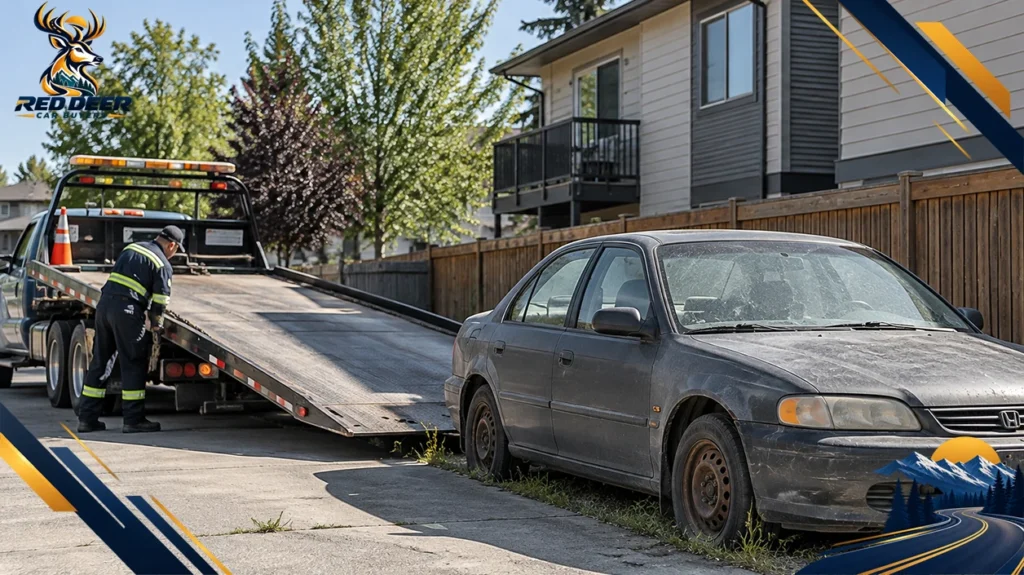
- Contact the City of Red Deer about removal. If the vehicle is a safety issue, a nuisance, or violates a local bylaw, the City may have the authority to have it towed, even if that doesn’t resolve who legally owns it. This is often the fastest way to get an unwanted vehicle off your land, even without settling the ownership question.
- Get legal advice before assuming Alberta’s unclaimed property system applies. The Unclaimed Personal Property and Vested Property Act is a holder-and-reporting framework built around specific rules for when property is presumed abandoned and who counts as a “holder.” It isn’t a general landowner-finds-a-car-so-report-it process, and getting advice before treating it that way is the safer route.
- Talk to a lawyer if real money is at stake. For anything beyond a low-value, clearly worthless vehicle, getting specific legal advice before you do anything is the safer move, especially if you’re considering selling it yourself. A single consultation is a small cost compared to being wrong about who actually owned a valuable vehicle.
None of these paths are mutually exclusive, either. It’s entirely reasonable to try contacting the owner first, fall back on a bylaw complaint to the City of Red Deer if that goes nowhere, and only bring in a lawyer if the vehicle turns out to be worth enough that getting the legal question wrong would actually cost you something.
How Do You Identify Who Owns an Abandoned Vehicle?
Dealing with an abandoned vehicle on your property in Red Deer most often turns out to be more manageable once the vehicle’s registration history has been established, so start there before considering anything else.
- Pull the VIN directly off the vehicle. It’s stamped on the dashboard on the driver’s side and repeated on the door jamb sticker.
- Order a Vehicle Information Report. For $21.10 through Alberta’s eServices portal, the VIR shows the vehicle’s Alberta registration history, status, odometer information when available, and the number of liens registered against it. It does not include the personal information of the current or previous registered owner; that’s protected information, only available to specific parties authorized under the Access to Motor Vehicle Information Regulation, or through a court order.
- Run a lien search through the Personal Property Registry at a Red Deer registry agent. This tells you whether a lender or another party has a registered financial interest in the vehicle, which matters if you’re weighing whether it’s worth pursuing at all.
- Reach out to the registered owner if you can identify one another way. Sometimes the vehicle itself has clues, old paperwork inside, a name known to a neighbour, or a plate that leads somewhere through other means. A conversation is often the fastest resolution when it’s possible at all, but don’t count on a VIR alone to get you there.
If these steps don’t establish who should be contacted, that’s when the municipal bylaw route and qualified legal advice become the realistic next steps, rather than assuming the vehicle is simply yours to deal with.
What Should You Document Along the Way?
Whichever path applies to your situation, keeping a paper trail protects you if anyone ever questions how you handled things. Good habits to build in from the start:
- Photograph the vehicle as soon as you notice it, including the VIN plate, the licence plate if there is one, and its overall condition. Dated photos establish exactly what you were dealing with and when.
- Log every attempt to contact the owner, including dates, phone numbers or addresses tried, and whether you got a response. This matters most if the vehicle turns out to have real value and someone disputes what happened later.
- Keep receipts for towing, storage, or repair costs you incur along the way. Under the tenant-vehicle process, these are the costs you’re entitled to deduct before any surplus goes to the province; even outside that process, records support your side of the story if a dispute comes up.
- Save any correspondence with the municipality or a lawyer, including complaint reference numbers and written advice. This shows you followed a reasonable process rather than acting on your own judgment alone.
None of this is required by any specific form or checklist, but a property owner who can produce dated photos, a contact log, and receipts is in a dramatically stronger position than one who can only say they waited a while and then dealt with it.
Can Red Deer Bylaw Officers Remove a Vehicle From Your Property?
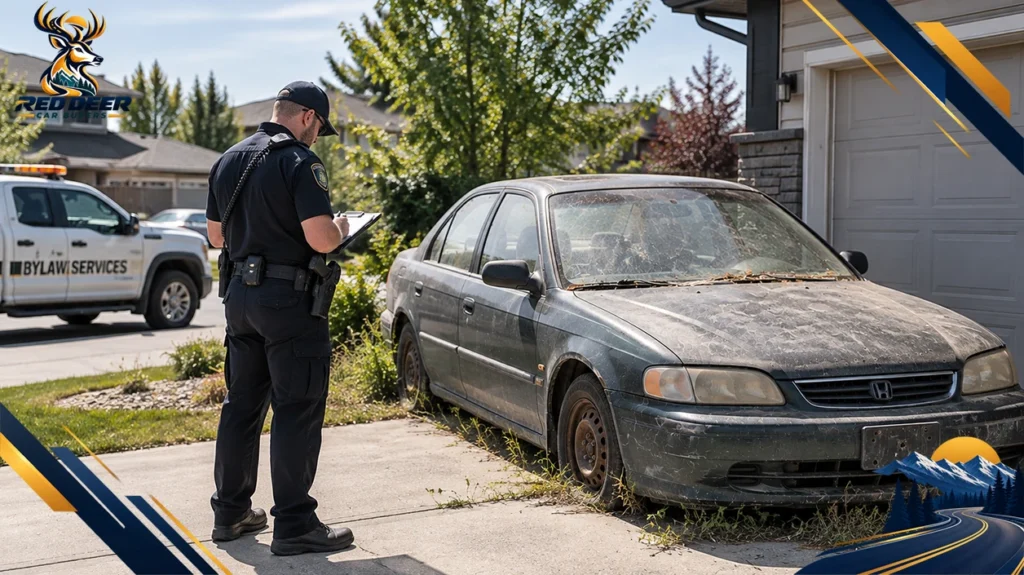
Often, yes, though it’s worth understanding what this does and doesn’t accomplish. Red Deer’s Community Standards Bylaw addresses nuisance and unsightly conditions, which can include a vehicle that’s become a safety hazard, an eyesore, or a magnet for other problems. Reporting it to the City’s bylaw service can trigger an investigation and, where the bylaw applies, enforcement action against the property in question.
What a bylaw complaint doesn’t do is transfer ownership to you. It addresses the nuisance issue and may result in removal or other enforcement, but it doesn’t answer the separate legal question of who’s entitled to sell or keep the vehicle. For that, you’re still working through either the tenant process above or the non-tenant options, depending on which applies.
What Happens If You Sell a Vehicle You Don't Actually Own?
This is the risk that makes cutting corners here a bad idea. Selling a vehicle you don’t have legal authority over, whether that authority comes from the Residential Tenancies Act process, a genuine ownership transfer, or a properly completed unclaimed property process, exposes you to a claim from the actual owner if they surface later. A buyer who unknowingly purchases a vehicle you didn’t have the right to sell can end up in a dispute neither of you wanted, and you could be on the hook for the value of a vehicle you never legally had a claim to in the first place.
Going through the correct process for your specific situation, whether that means the tenant-vehicle rules, a municipal bylaw removal, or a lawyer’s advice on the unclaimed property route, is what actually protects you if the original owner ever comes back asking questions.
Sold Your Way Through the Paperwork in Red Deer? We'll Take It From There
Once you’ve gone through the right process, whether that’s the tenant-vehicle rules under the Residential Tenancies Act or proper legal advice on a non-tenant situation, and you’re actually in a position to sell, Red Deer Car Buyers can make things simple from there. We buy vehicles in all kinds of condition, including ones that have been sitting unused for a while, and we’re used to working with sellers who need to show documentation proving they have the right to sell. Reach us at hello@reddeercarbuyers.ca or (587) 797-0700.
- Free Quote
- Same-Day Payment
- Local Red Deer Team
Common Questions
Not on its own. Simply possessing a vehicle doesn't make it legally yours in Alberta, no matter how long it's sat on your land. Depending on the circumstances, you may need to go through the Residential Tenancies Act process, a municipal bylaw process, or Alberta's unclaimed property system before you have any legal right to keep or sell it.
Neither of those facts changes the legal ownership question on its own. A vehicle with expired registration or missing plates can still belong to someone, and the absence of current paperwork doesn't give you any extra rights to it. A VIR helps establish the vehicle's Alberta registration history and status, but it won't disclose the registered owner's personal information.
For a former tenant's vehicle, the Residential Tenancies Act sets a 30-day storage requirement in most cases before you can proceed to a sale, unless one of the value or condition exceptions applies. For a non-tenant's vehicle, there's no fixed waiting period in provincial law, though the City of Red Deer's bylaw process may have its own timelines for nuisance complaints.
Yes. Vehicles on public roads generally fall under the City of Red Deer's parking and traffic bylaws, with different enforcement mechanisms than vehicles on private property. This guide focuses on vehicles on private land, where the Residential Tenancies Act and municipal nuisance bylaws are the relevant tools rather than street parking rules.
For a former tenant's vehicle, the Residential Tenancies Act framework allows you to deduct reasonable costs, including storage, from the sale proceeds before any surplus goes to the province. For a non-tenant situation, this is murkier without a clear statutory answer, so confirm with a lawyer before billing anyone directly.
Pull the VIN and order a Vehicle Information Report to see what you're actually dealing with, then try to determine whether it belonged to a tenant or someone unconnected to you. That single distinction determines which legal process applies and saves you from guessing at a solution that doesn't match your actual situation.
What's the Right Way to Handle an Abandoned Vehicle in Red Deer?
Start by figuring out whether the vehicle belonged to a tenant, since that single fact determines which legal process applies. A tenant’s abandoned vehicle follows a clear path under the Residential Tenancies Act, with specific value thresholds and a 30-day storage requirement in most cases. Anyone else’s vehicle requires more caution: identify the owner if you can, involve the City of Red Deer if it’s a safety or nuisance issue, and don’t assume that time and possession alone hand you ownership. Skipping the proper process to sell a vehicle you don’t actually have clear rights to is the one mistake that can turn a minor property annoyance into a real legal problem.
References
- Residential Tenancies Act, SA 2004, c R-17.1, s. 31. CanLII
- Residential Tenancies Ministerial Regulation, Alta Reg 211/2004, s. 5. CanLII
- Unclaimed Personal Property and Vested Property Act, SA 2007, c U-1.5. CanLII
- Government of Alberta. Unclaimed Property
- Government of Alberta. Vehicle Information Report
- City of Red Deer. Bylaw Complaints and Questions